Explore musical features through explanations and short listening examples, then find other excerpts with the same features. The 105 entries cover named patterns, descriptions of musical motion, source annotations, and cases where interpretation remains unresolved.
Each example distinguishes evidence matched to the same interval from inherited descriptions and source-provider labels. “Existing structural description based on the initial edition’s score/MIDI” means that an earlier description has been organized here; it does not mean that every original score has been re-examined or every example independently checked by listening. Read the evidence, terms of use, and limits of each example.
Rhythm and meter
Meter and recurring cycles
Description of local structure
Two-beat measure cycle (2/4)
A bar framework that groups two quarter-note beats together. This is separate from the number of notes within each beat: even with many short sounds, the bar cycle remains two beats long.
Listen for: In the samba-enredo ensemble, try counting “1–2” repeatedly without being pulled along by the faster drum strokes. Use the recording’s beat annotations to follow each two-beat boundary. The first sound in the excerpt is not necessarily “1.”
Samba-enredo / [0013] M4-13-SE
BRID · brid:0013 Original recording: 13.521000–17.389000 seconds
Source beat annotations rechecked against the excerpt
What was checked in this example: The BRID recording contains four “1–2” cycles between 13.521 and 17.389 seconds. Beat 1 occurs at 0.000, 0.970, 1.919 and 2.910 seconds in the player. The next beat 1 falls at the endpoint and is not included. The onsets of individual instruments have not been identified. Primary source checked
Evidence, sources and terms of use
Published listening excerpt. The original beat annotations were matched using the recording ID and MD5. The published interval contains at least four sequences of beat 1, beat 2 and the following beat 1. Excerpts do not necessarily begin at a barline; no instrument-specific pattern is identified.
CC BY 4.0: Lucas S. Maia, Pedro D. de Tomaz Júnior, Magdalena Fuentes, Martín Rocamora, Luiz W. P. Biscainho, Maurício V. M. da Costa, Sara Cohen (2018), BRID. CC BY 4.0 https://creativecommons.org/licenses/by/4.0/ . Excerpted, with 5 ms fades at both ends; no level adjustment.
What this example can tell us: This entry describes a source-based two-beat framework. It does not mean that beat 1 is louder in every bar or that the music necessarily sounds like a march. The cycle may be difficult to hear in the excerpt alone.
A bar cycle that groups four beats together. Separating the “1–2–3–4” framework from the sounds and rests placed within it helps you compare different rhythms sharing the same cycle.
Listen for: Keep counting a steady beat and notice which sounds return after four counts. Follow high sounds and rests as well as low drum strokes, distinguishing beat-by-beat repetition from repetition across a whole bar.
In the candombe example, the first annotated downbeat is at 0.000 seconds in the excerpt; the next ones are at 1.816, 3.600 and 5.392 seconds. Try counting “1–2–3–4” between them. Beat and downbeat annotations
Researchers’ beat annotations rechecked against the excerpt
What was checked in this example: The REDATA beat annotations confirm eight consecutive “1–2–3–4” cycles in bars 12–19. This illustrates the ensemble’s beat framework; individual drum onsets and a clave pattern have not been identified. Primary source checked
Evidence, sources and terms of use
Published listening excerpt: eight bars of ensemble playing, selected using the authors’ beat annotations. Instrument-specific patterns and clave have not been identified.
The same listening WAV was matched to the official beat annotations: eight consecutive four-beat cycles (1–2–3–4). The downbeats occur at 0.000, 1.816, 3.600, 5.392, 7.192, 8.998, 10.761 and 12.580 seconds in the excerpt. This describes the ensemble cycle, not an identified pattern for any individual percussion instrument. Additional evidence
CC BY 4.0:Martín Rocamora and Luis Jure, Uruguayan candombe drumming - beat and downbeat tracking data set, REDATA v1.0 (2024), DOI 10.60895/redata/AY9CGZ. CC BY 4.0. Excerpted, mono downmix, resampled and fixed gain0.5 before PCM16 quantization. No restoration of source saturation. Performers collectively acknowledged in source README; recording-specific identities not supplied. Nunes, Rocamora, Jure & Biscainho, ISMIR 2015, pp.264–270.
What this example can tell us: A four-beat framework does not mean that every instrument repeats its pattern once per bar. This classification alone cannot establish a particular dance, accent pattern or perceived meter in the performance.
An audio example described as 3/4 by its uploader. The notation 3/4 places three quarter-note beats in a bar, but this label primarily records the source’s description.
Listen for: Count “1–2–3” quietly and listen for where changes in the bass or accompaniment return. Compare three beats with three small sounds within one beat, taking care not to confuse them.
3/4 (uploader’s description): live drums and percussion (#271430)
Non-4/4 performance candidates:Freesound · ref:FS:271430 Freesound #271430. First 10.00 seconds of the official preview.
Uploader’s description checked; performed meter not independently verified
What was checked in this example: The uploader’s description for Freesound #271430 states 3/4 and 110 BPM. These are metadata attached to the recording, not independently measured beat positions or tempo from the audio. Primary source checked
Evidence, sources and terms of use
Performance information supplied by the source/uploader; no independent verification. The uploader’s meter label is retained. Beat grouping and accents in the performance are not assessed here.
CC BY 4.0: OverlookHotelRecords / Freesound #271430. CC BY 4.0. The first 10 seconds of the official MP3 preview were excerpted, a 20 ms fade was applied at the end, and the result was converted to AAC.
What this example can tell us: This does not mean the uploader’s label was independently confirmed by transcription or listening. The meter label alone establishes neither a dance type such as a waltz nor a recurring pattern of strong and weak beats.
An example marked 4/4 in the existing source. A bar has the duration of four quarter notes; that span can be filled with long notes, shorter notes and rests.
Listen for: Keep a steady quarter-note beat and listen to how long and short notes fit within “1–2–3–4.” Continuing to count through silent points helps separate the number of attacks from the number of beats.
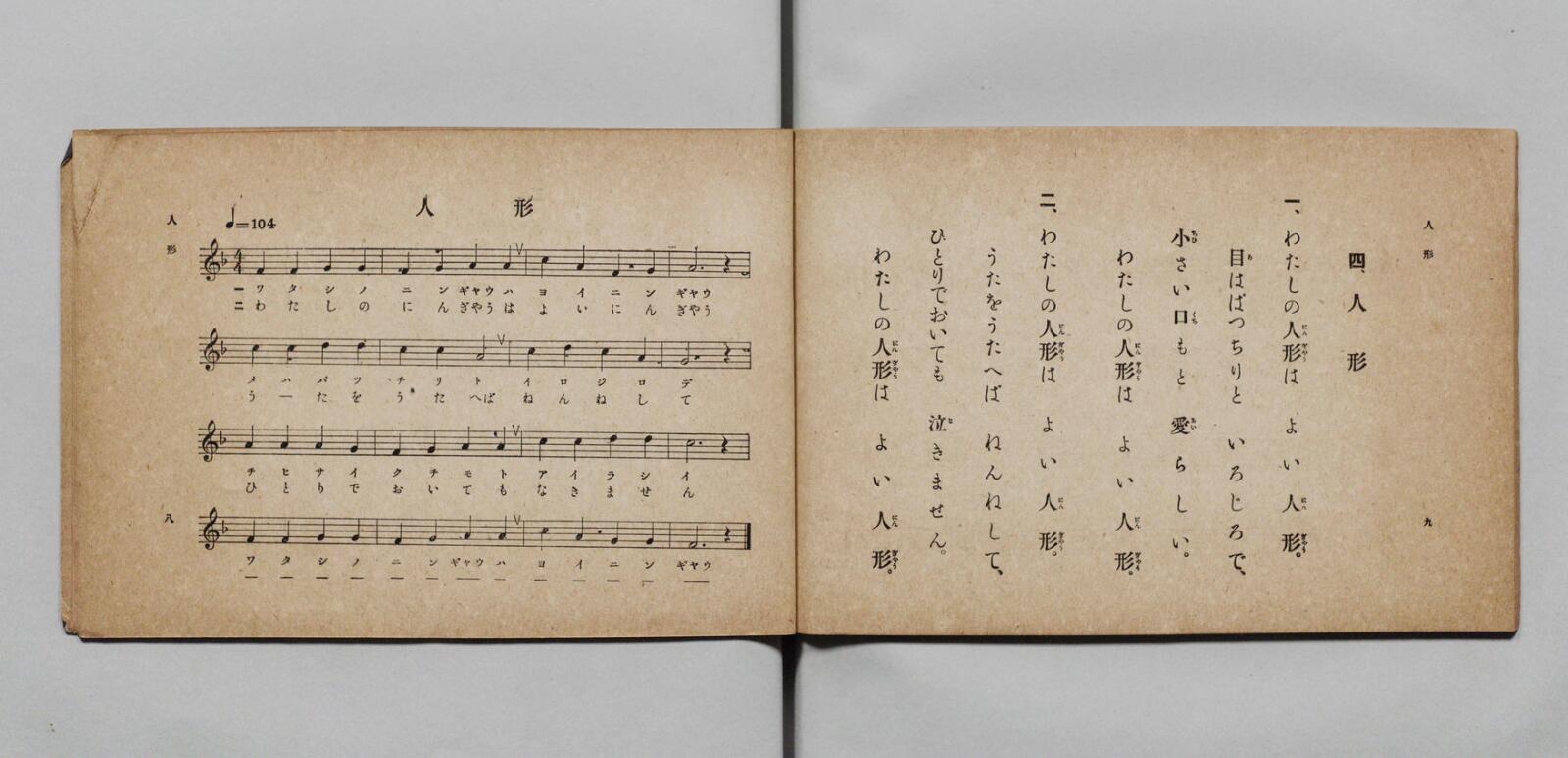
Ningyō (Doll)
Historical Japanese scores · ref:HU:4103:7 Ministry of Education, Jinjō Shōgaku Shōka, Grade 1 (1911). Image 7, left-hand page, opening two bars.
Time signature visually checked in the original score; synthesized melody
What was checked in this example: The opening 4/4 signature was confirmed in “Ningyō,” image 7 of item 4103, Jinjō Shōgaku Shōka, Grade 1 (1911), held by Hiroshima University. This checks the score’s notation, not every note in the synthesized excerpt or a historical performance. Primary source checked
Evidence, sources and terms of use
Existing score annotation, with no independent re-matching. The description and local structural notes were carried over from the initial score excerpt. The synthesized audio does not recreate a historical performance or timbre.
Score: marked as out of copyright. Audio: newly synthesized for this site. Ministry of Education, Jinjō Shōgaku Shōka, Grade 1 (1911), Hiroshima University Library. Ministry of Education school song; no individual composer is named in the score. The main melody was transcribed and synthesized electronically without samples.
What this example can tell us: The evidence is the notation and annotation in the existing source. This is not an independent determination of 4/4 from the short audio clip, and does not establish downbeat emphasis, genre or an unchanged meter throughout the work.
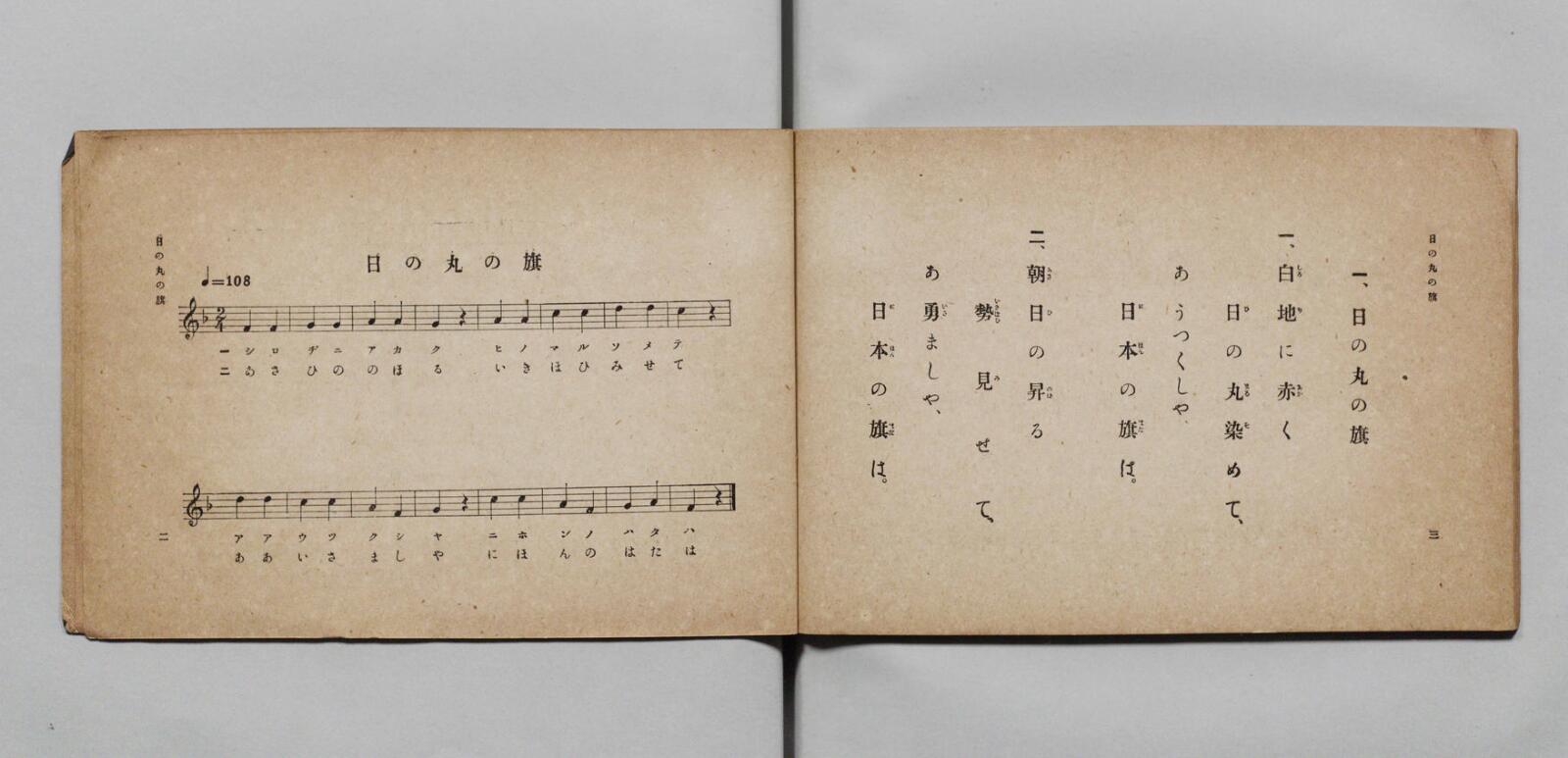
An example marked 2/4 in the existing source. A bar spans two quarter notes, with room for various subdivisions and rests inside those two beats.
Listen for: Count “1–2” while listening to the melody of “Hinomaru no Hata.” Rather than dividing the music after every two notes, follow the changing note lengths and check the original barlines to locate each bar’s beginning.
Time signature visually checked in the original score; synthesized melody
What was checked in this example: The opening 2/4 signature was confirmed in “Hinomaru no Hata,” image 4 of item 4103, Jinjō Shōgaku Shōka, Grade 1 (1911), held by Hiroshima University. This checks the score’s notation, not every note in the synthesized excerpt or a historical performance. Primary source checked
Evidence, sources and terms of use
Existing score annotation, with no independent re-matching. The description and local structural notes were carried over from the initial score excerpt. The synthesized audio does not recreate a historical performance or timbre.
Score: marked as out of copyright. Audio: newly synthesized for this site. Ministry of Education, Jinjō Shōgaku Shōka, Grade 1 (1911), Hiroshima University Library. Teiichi Okano (1878–1941; National Diet Library authority record). The main melody was transcribed and synthesized electronically without samples.
What this example can tell us: This label records the source’s time signature. The audio alone has not been used to distinguish it from a different beat unit such as 2/2. Neither tempo nor dance type follows from this notation alone.
A drum performance labeled 3/4 in the distributed material. It refers to a bar of three quarter-note beats; whether those beats divide in two or three, and which are accented, are separate questions.
Listen for: Start by counting three steady beats, then follow the kick and snare separately. Do not judge from a single instrument alone; listen also for strokes or rests that cross barlines.
Time signatures in the distributed CSV and MIDI for the same performance rechecked
What was checked in this example: Both the distributed CSV and the opening MIDI time signature for drummer1/session2/1 specify 3/4. A MIDI bar lasts about 1.15 seconds. This time signature alone does not determine finer beat grouping or performance accents. Primary source checked
Evidence, sources and terms of use
Published listening excerpt. The CSV meter label agrees with the same-edition MIDI. No beat grouping, accents or dance-specific pattern are assigned.
CC BY 4.0: Groove MIDI Dataset v1.0.0, Google LLC. Performance drummer1/session2/1; drummer1. CC BY 4.0. Changes: excerpt, stereo mean if needed, attenuation if needed, 5ms fades. Original Roland TD-11 output, not acoustic microphone recording. The excerpt WAV was subsequently converted to AAC, with resampling where needed.
What this example can tell us: The meter comes from the source annotation. This label does not assess subdivision, swing, dynamics or dance character. The same instrument need not sound on all three beats.
A drum performance labeled 6/8 in the distributed material. In the usual compound-meter reading, three eighth notes form one larger beat, giving two larger beats per bar.
Listen for: Try counting six small units, then grouping them as “1-and-a, 2-and-a.” Compare which grouping is suggested by the placement of the kick and cymbals.
Time signatures in the distributed CSV and MIDI for the same performance rechecked
What was checked in this example: Both the distributed CSV and the opening MIDI time signature for drummer6/session1/1 specify 6/8. A MIDI bar lasts about 2.57 seconds. Another card uses the same excerpt to examine kick onsets near the starts of the two groups in the opening two bars. This time signature alone does not determine finer grouping or performance accents. Primary source checked
CC BY 4.0: Groove MIDI Dataset v1.0.0, Google LLC. Performance drummer6/session1/1; drummer6. CC BY 4.0. Changes: excerpt, stereo mean if needed, attenuation if needed, 5ms fades. Original Roland TD-11 output, not acoustic microphone recording. The excerpt WAV was subsequently converted to AAC, with resampling where needed.
What this example can tell us: Subdivision and accents have not been independently assessed for this group of recordings. A source label of 6/8 does not prove that the performance will sound clearly grouped 3+3, or make it equivalent to a shuffle.
An example for which the choice between 6/8 and 12/8 has not yet been made. Both can involve subdivisions in threes, but they group these into two or four larger beats per bar.
Listen for: If the small drum strokes feel grouped in threes, try counting those groups first in twos, then in fours. Compare where the kick or snare pattern returns, without deciding the bar boundaries from this short excerpt alone.
6/8 or 12/8 (unresolved): drum groove (#842686)
Non-4/4 performance candidates:Freesound · ref:FS:842686 Freesound #842686. First 9.14 seconds of the official preview.
Meter interpretation unresolved; not a confirmed example of either meter
What was checked in this example: The uploader of Freesound #842686 offers both 6/8 and 12/8 interpretations. Hearing subdivisions in threes does not by itself establish bar boundaries, so the interpretation remains unresolved. Primary source checked
Evidence, sources and terms of use
Performance information supplied by the source/uploader; no independent verification. The uploader’s meter label is retained. Beat grouping and accents in the performance are not assessed here.
CC0 1.0: lennartgreen / Freesound #842686. CC0 1.0. Official MP3 preview converted to AAC.
What this example can tell us: This classification records uncertainty; it does not mean the music switches between the two meters. The short excerpt may not reveal the bar boundaries, and a score or longer context may be needed.
An example treated as 3/4 in the existing source. The notation places three quarter-note beats in a bar and provides a framework for examining the placement of notes.
Listen for: Keep the bar framework as “1–2–3” and follow how many beats a long note spans, or how shorter notes divide a beat. Notice that a melody does not necessarily stop at a barline.
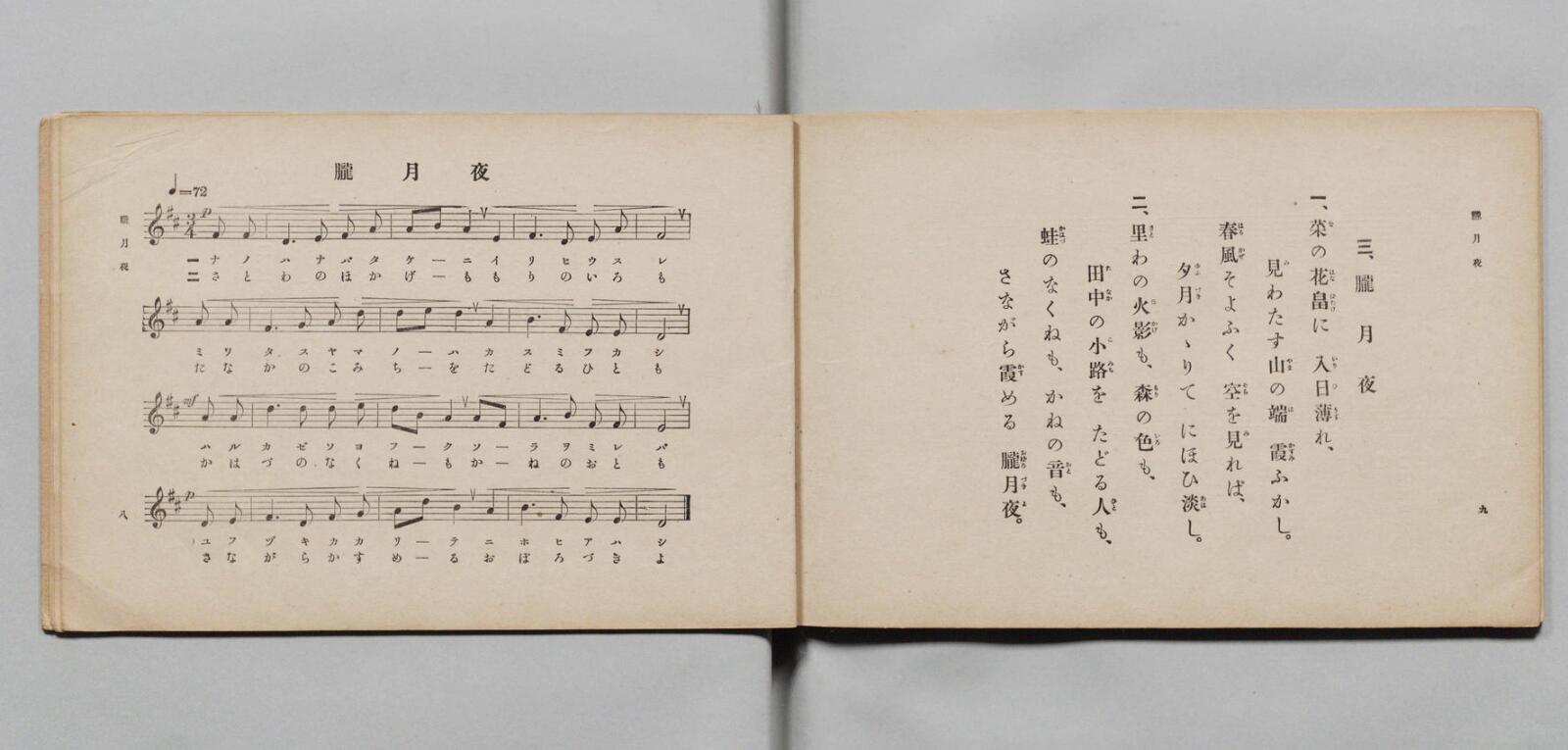
Oborozukiyo (Hazy Moonlit Night)
Historical Japanese scores · ref:HU:4078:7 Ministry of Education, Jinjō Shōgaku Shōka, Grade 6 (1914). Image 7, left-hand page, first system.
Time signature visually checked in the original score; synthesized melody
What was checked in this example: The opening 3/4 signature was confirmed in “Oborozukiyo,” image 7 of item 4078, Jinjō Shōgaku Shōka, Grade 6 (1914), held by Hiroshima University. This checks the score’s notation, not every note in the synthesized excerpt or a historical performance. Primary source checked
Evidence, sources and terms of use
Existing score annotation, with no independent re-matching. The description and local structural notes were carried over from the initial score excerpt. The synthesized audio does not recreate a historical performance or timbre.
Score: marked as out of copyright. Audio: newly synthesized for this site. Ministry of Education, Jinjō Shōgaku Shōka, Grade 6 (1914), Hiroshima University Library. Teiichi Okano (1878–1941; National Diet Library authority record). The main melody was transcribed and synthesized electronically without samples.
What this example can tell us: This label presents the meter recorded in the source. It is not based on an independent transcription of a performance, and does not establish the presence of waltz accompaniment or emphasis on beat 1.
An example labeled 7/8 by the uploader. A bar spans seven eighth notes. Groupings such as 2+2+3 are possible, but the time signature alone does not identify the grouping.
Listen for: Count seven short shaker sounds at a time and listen for where changes return. You can try 2+2+3 or 3+2+2, but neither has been confirmed as this recording’s grouping.
7/8 (uploader’s description): hand shaker (#324339)
Non-4/4 performance candidates:Freesound · ref:FS:324339 Freesound #324339. First 5.89 seconds of the official preview.
7/8 in the upload title; grouping and tempo not confirmed
What was checked in this example: The title of Freesound #324339 gives “7-8” and “107bpm,” but the uploader says in the description that they are unsure of the tempo. Neither 107 BPM nor a grouping such as 2+2+3 is treated as a verified finding. Primary source checked
Evidence, sources and terms of use
Performance information supplied by the source/uploader; no independent verification. The uploader’s meter label is retained. Beat grouping and accents in the performance are not assessed here.
CC BY 3.0: Puniho / Freesound #324339. CC BY 3.0. Official MP3 preview converted to AAC.
What this example can tell us: This entry follows the uploader’s meter description; it does not identify a particular beat grouping or dance. The suggested ways of counting should not be read as confirmed rhythmic groupings in the recording.
A drum performance labeled 5/4 in the distributed material. A bar spans five quarter-note beats. Possible groupings such as 2+3 or 3+2 are distinct from the actual placement of drum strokes.
Listen for: Count “1–2–3–4–5,” then try placing a division within that span. Listen for whether kick and snare reinforce the same grouping or emphasize different positions.
Time signatures in the distributed CSV and MIDI for the same performance rechecked
What was checked in this example: Both the distributed CSV and the opening MIDI time signature for drummer1/session2/111 specify 5/4. A MIDI bar lasts about 2.73 seconds. This time signature alone does not determine finer beat grouping or performance accents. Primary source checked
Evidence, sources and terms of use
Published listening excerpt. The CSV meter label agrees with the same-edition MIDI. No beat grouping, accents or dance-specific pattern are assigned.
CC BY 4.0: Groove MIDI Dataset v1.0.0, Google LLC. Performance drummer1/session2/111; drummer1. CC BY 4.0. Changes: excerpt, stereo mean if needed, attenuation if needed, 5ms fades. Original Roland TD-11 output, not acoustic microphone recording. The excerpt WAV was subsequently converted to AAC, with resampling where needed.
What this example can tell us: Subdivision, grouping and dynamics have not been assessed. The source’s 5/4 label does not prove a 2+3 or 3+2 grouping; rests and subdivisions within the bar require separate examination.
A drum performance labeled 5/8 in the distributed material. Each bar spans five eighth notes. Groupings such as 2+3 and 3+2 are possibilities, not established interpretations of each example.
Listen for: Count five small units and follow where kick or cymbal strokes return. Compare whether you hear two groups of unequal length or five equally weighted units.
Time signatures in the distributed CSV and MIDI for the same performance rechecked
What was checked in this example: Both the distributed CSV and the opening MIDI time signature for drummer5/session1/8 specify 5/8. A MIDI bar lasts about 0.93 seconds. This time signature alone does not determine finer beat grouping or performance accents. Primary source checked
Evidence, sources and terms of use
Published listening excerpt. The CSV meter label agrees with the same-edition MIDI. No beat grouping, accents or dance-specific pattern are assigned.
CC BY 4.0: Groove MIDI Dataset v1.0.0, Google LLC. Performance drummer5/session1/8; drummer5. CC BY 4.0. Changes: excerpt, stereo mean if needed, attenuation if needed, 5ms fades. Original Roland TD-11 output, not acoustic microphone recording. The excerpt WAV was subsequently converted to AAC, with resampling where needed.
What this example can tell us: The time signature comes from the source. This classification does not independently establish subdivisions, accents or the audible distinction from 5/4. The number five alone does not identify a particular culture or dance.
A rhythm shaped by a dotted note and shorter notes around it. A dot adds half of the note’s original value: a dotted eighth followed by a sixteenth has a written long-to-short ratio of 3:1.
Listen for: Focus on the move from the longer note to the shorter one and imagine how it would differ if the time were divided equally. Listening for the next note’s onset, rather than just the decay of the first, makes the long–short placement easier to follow.
Chopin: Prelude in A major, Op. 28, No. 7
Mutopia Project · mutopia:NMP-020 Pickup through beat 2 of bar 2
example with a structural description
Evidence, sources and terms of use
Published listening excerpt. Existing structural description based on the initial edition’s score and MIDI.
Public Domain (designation for this edition on Mutopia): based on Edition Peters; typeset by Magnus Lewis-Smith (Mutopia Project).
What this example can tell us: Not every long–short rhythm uses dotted notation. Nor does every example here repeat a single 3:1 pair. The timing of a performance need not match the notated ratio exactly.
A structure in which long and short notes, or differing durations, create a contrast within the same passage. Not only the number of notes but the time occupied by each one shapes the movement and spacing of the pattern.
Listen for: Use a sustained note as a reference and listen for shorter notes around it. If another voice keeps moving, alternate your attention between the held and moving voices to hear the difference in duration.
Schubert, Death and the Maiden
Mutopia Project · mutopia:NMP-079 bars 1–2; piano, both hands
example with a structural description
Evidence, sources and terms of use
Published listening excerpt. Existing structural description based on the initial edition’s score and MIDI.
Public Domain (designation for this edition on Mutopia): based on Breitkopf & Härtel (1884–1897); typeset by Ph. Raynaud (Mutopia Project). Public Domain is stated on the official Mutopia page and in the same edition’s LilyPond header.
What this example can tell us: This local classification describes differences in note value. It does not directly indicate dynamics, accents or emotion. Notated duration, actual onset spacing and a sound’s reverberant decay must be distinguished.
A tuplet divides a fixed span of time into a different number of notes from the usual division. For example, a triplet divides into three a span normally divided into two. The reference duration matters.
Listen for: Keep a steady beat and follow how many onsets fit inside it. If another voice uses the usual subdivision, compare the two: the change is in how the same duration is divided, not necessarily in tempo.
Sonatina Op.36 No.1, II Andante
Mutopia Project · mutopia:NMP-023 mm1–2 left hand
example with a structural description
Evidence, sources and terms of use
Published listening excerpt. The existing structural description explicitly identifies “triplet broken chords.” No new score or MIDI matching was performed.
Public Domain (designation for this edition on Mutopia): Brian D. Rude, Mutopia Project; Sonatina Album, G. Schirmer, Inc. Copyright 1893
What this example can tell us: This classification alone does not specify the tuplet’s number of notes or note values. Nor is every normal three-way subdivision, as in 6/8, a triplet. Check the original notation and the passage together.
A pattern that fills a larger beat or note value with shorter notes. Subdivision is separate from tempo: many short notes can fit inside a slow beat.
Listen for: Before following every small onset, establish the underlying steady beat. Listen for how many notes fit inside it and whether their density changes, separating tempo from subdivision.
Handel, Preludio from the Aylesford Pieces
Mutopia Project · mutopia:NMP-067 bars 1–2; top voice only
example with a structural description
Evidence, sources and terms of use
Published listening excerpt. Existing structural description based on the initial edition’s score and MIDI.
Public Domain (designation for this edition on Mutopia): Georg Friedrich Händel; Preludio, Aylesford Pieces; source Edition Schott 1930; typeset by Bas Wassink; Mutopia-2013/02/21-156; Public Domain.
What this example can tell us: This label identifies the presence of shorter, subdivided note values. It does not place every example in one category such as sixteenth notes, tuplets or fast playing. Note counts and durations must be checked at each cited passage.
An example described by its uploader as a triplet-based groove. It provides a starting point for considering a beat divided into three parts, or patterns using some of those positions.
Listen for: Divide the space between steady beats into three: “ta-ta-ta.” Listen for whether all three positions sound, some are left empty, or another instrument fills the gaps.
6/8 or 12/8 (unresolved): drum groove (#842686)
Non-4/4 performance candidates:Freesound · ref:FS:842686 Freesound #842686. First 9.14 seconds of the official preview.
Triplet-based in the upload title/tags; meter unresolved
What was checked in this example: For Freesound #842686, the evidence is “triplet” in the title and tags. The uploader’s triplet-based classification is recorded, but the clip is not treated as a confirmed example of 6/8, 12/8 or shuffle. Primary source checked
Evidence, sources and terms of use
Official uploader description only, not an independent verification of meter or shuffle. Published excerpt: 0–9.143 seconds. The official title is “Groove Triplet,” with the tag “triplet.” The published clip matches the existing deployment record for the same recording. The 6/8 and 12/8 interpretations remain unresolved.
CC0 1.0: lennartgreen / Freesound #842686. CC0 1.0. Official MP3 preview converted to AAC.
What this example can tell us: This preserves the provider’s wording; it does not report a measurement showing that every onset falls on an exact three-part division. Triplets, swing and shuffle should not be treated as interchangeable terms.
A pattern with snare-family onsets near beats 2 and 4 in 4/4. Here, “backbeat pattern” is limited to passages where the distributed MIDI’s beat positions have been matched to the onsets.
Listen for: Count a steady “1–2–3–4” and listen for where the snare-family sounds fall around “2” and “4.” Follow kick and cymbal separately and check for snare strokes on other beats or between them.
Published listening excerpt matched to the corresponding interval in the distributed MIDI event table. Two complete 4/4 bars, referenced to MIDI tick 0. Onsets within approximately ±0.145 quarter-note beats are counted; independent listening and dynamics are not assessed.
CC BY 4.0: Groove MIDI Dataset v1.0.0, Google LLC. Performance drummer1/eval_session/1; drummer1. CC BY 4.0. Changes: excerpt, stereo mean if needed, attenuation if needed, 5ms fades. Original Roland TD-11 output, not acoustic microphone recording. The excerpt WAV was subsequently converted to AAC, with resampling where needed.
What this example can tell us: Beat positions were matched within a tolerance on the MIDI timeline. This does not establish that beats 2 and 4 are loudest, that no other snare strokes occur, or that the performance belongs to a particular genre. It is also distinct from independent listening verification.
Bass-drum onsets occur near each beat in the distributed MIDI over the observed passage. The example covers two bars of 4/4, using beats 1, 2, 3 and 4 as reference positions.
Listen for: Tap an even beat with your foot and follow how the low kick sound aligns with it. Try counting the kick alone even as other strokes come and go.
① ・ ② ・ ③ ・ ④
Circled numbers mark the onset positions being examined. They do not indicate loudness or whether other strokes are present.
Published listening excerpt: kick on every MIDI beat. The excerpt was matched to the distributed MIDI event table over two complete 4/4 bars, referenced to MIDI tick 0. Onsets within approximately ±0.145 quarter-note beats are counted; independent listening and dynamics are not assessed.
CC BY 4.0: Groove MIDI Dataset v1.0.0, Google LLC. Performance drummer1/session1/101; drummer1. CC BY 4.0. Changes: excerpt, stereo mean if needed, attenuation if needed, 5ms fades. Original Roland TD-11 output, not acoustic microphone recording. The excerpt WAV was subsequently converted to AAC, with resampling where needed.
What this example can tell us: This describes onsets at each beat. It does not determine whether additional strokes occur between beats or establish the genre of the entire performance.
A pattern with a snare stroke on beat 3 of a four-beat group, but none on beats 2 or 4.
Listen for: Count “1–2–3–4” and locate the snare around beat 3. Noticing the absence of snare near beats 2 and 4 helps distinguish it from the backbeat examples.
1 ・ 2 ・ ③ ・ 4
Circled numbers mark the onset positions being examined. They do not indicate loudness or whether other strokes are present.
Fill moving across the toms / drummer1/session1/10
Published listening excerpt matched to the corresponding interval in the distributed MIDI event table. One complete 4/4 bar, referenced to MIDI tick 0. Onsets within approximately ±0.145 quarter-note beats are counted; independent listening and dynamics are not assessed.
CC BY 4.0: Groove MIDI Dataset v1.0.0, Google LLC; performance drummer1, drummer1/session1, ID drummer1/session1/10. CC BY 4.0. Gillick, Roberts, Engel, Eck & Bamman (ICML 2019). Changes: excerpting; mono conversion (averaging stereo sources only); low-pass filtering; 44.1 kHz to 22.05 kHz conversion; 5 ms fades at both ends.
What this example can tell us: This is a local placement measured against the distributed MIDI’s beat positions within approximately ±0.145 quarter-note beats. It does not assess additional sounds between beats, dynamics, neighboring bars or half-time as a stylistic category.
Cymbal strokes fall near the midpoint between quarter-note beats, on the intervening eighth-note position. This is not a general label for any position between beats.
Listen for: Tap quarter notes with your foot and count “1-and-2-and.” Listen for cymbal sounds on “and,” rather than at the moment your foot lands.
Fill moving across the toms / drummer1/session1/10
Published listening excerpt: offbeat cymbals in the MIDI. The excerpt was matched to the distributed MIDI event table over one complete 4/4 bar, referenced to MIDI tick 0. Onsets within approximately ±0.145 quarter-note beats are counted; independent listening and dynamics are not assessed.
CC BY 4.0: Groove MIDI Dataset v1.0.0, Google LLC; performance drummer1, drummer1/session1, ID drummer1/session1/10. CC BY 4.0. Gillick, Roberts, Engel, Eck & Bamman (ICML 2019). Changes: excerpting; mono conversion (averaging stereo sources only); low-pass filtering; 44.1 kHz to 22.05 kHz conversion; 5 ms fades at both ends.
What this example can tell us: The offbeat finding applies only to the cited passage. This label does not identify open versus closed sounds or establish that the entire piece uses offbeat cymbals exclusively.
A combination of sounding positions and notated rests. A rest does not necessarily mean complete silence in the audio.
Listen for: Listen to the gaps before the next attack as well as the sequence of notes. Where resonance continues, compare the score with the absence of a new onset, rather than with the moment the sound finally fades.
Kinderszenen Op.15 No.1, Von fremden Ländern und Menschen
Public Domain (designation for this edition on Mutopia): Ying-Chun Liu, Mutopia Project; Leichte Stucke, 1900
What this example can tell us: A rest in one voice is different from all parts stopping together. This label alone does not establish repetition or syncopation.
A note begins on one beat and continues across the next beat or a barline, without being rearticulated at the boundary.
Listen for: Remember the initial attack and keep counting. If there is no new onset at the next beat and the earlier note continues, compare that with a tie or long note value in the score.
Elite Syncopations (synthesized audio)
Mutopia Project · mutopia:NMP-048 Bars 1–2
example with a structural description
Evidence, sources and terms of use
Published listening excerpt. Existing structural description based on the initial edition’s score and MIDI.
Public Domain (designation for this edition on Mutopia): Scott Joplin; Benjamin Bloomfield; John Stark & Son; Mutopia Project
What this example can tell us: A decaying resonance and a notated sustain are different. Refer to the individual example for the beats crossed and its relationship to strong beats.
A melody begins before beat 1 of the first complete bar. Distinguish the incomplete opening bar containing the pickup from the complete bar that follows.
Listen for: In the synthesized school song “Meiji Tennō Gyosei,” the opening D, from 0 to about 0.65 seconds, is the pickup. In Bach’s BWV 636, it is the opening A, from 0 to about 0.97 seconds. In both, count the following barline as “1,” not the first note.
In these examples: one preliminary note → | first complete bar
Meiji Tennō Gyosei (Imperial Verse of Emperor Meiji)
Historical Japanese scores · ref:HU:4078:4 Ministry of Education, Jinjō Shōgaku Shōka, Grade 6 (1914). Image 4, left-hand page, opening pickup and two bars.
example with a structural description
Evidence, sources and terms of use
Hiroshima University’s score, transcribed durations and deployment audio waveform were matched. This is synthesized audio, not singing or a live performance. Opening interval: 0–0.652167 seconds. “Meiji Tennō Gyosei,” Jinjō Shōgaku Shōka, Grade 6 (1914), item 4078, image 4. The opening D4 quarter note precedes the first complete bar in the score.
Matched to the same passage as the public excerpt: “Meiji Tennō Gyosei,” Jinjō Shōgaku Shōka, Grade 6 (1914), item 4078, image 4. The opening D4 quarter note precedes the first complete bar in the score. Additional evidence
Score: marked as out of copyright. Audio: newly synthesized for this site. Ministry of Education, Jinjō Shōgaku Shōka, Grade 6 (1914), Hiroshima University Library. Ministry of Education school song; no individual composer is named in the score. The main melody was transcribed and synthesized electronically without samples.
Bach, Vater unser im Himmelreich (BWV 636)
Mutopia Project · mutopia:NMP-409 pickup and bars 1–2; upper voice
example with a structural description
Evidence, sources and terms of use
Mutopia-2006/03/30-714, soprano only. The synthesized excerpt, original MIDI and LilyPond score positions were matched. The opening 0–0.967741 seconds of the synthesized audio correspond to original MIDI ticks 0–384, at PPQ 384. The soprano in Bach’s BWV 636 begins with a one-quarter-note pickup; the first complete bar begins at original MIDI tick 384. The timing and pitches of the nine selected soprano notes agree. Deployment WAV SHA256:10c8a492a12d04f82f2c4beaebff985f7c2bcc4ab124eb493fc1df9a5d7616b2. As this is a single voice, it is not used to assess the chorale’s harmony or relationships with other voices.
Public Domain (designation for this edition on Mutopia): Johann Sebastian Bach; Vater unser im Himmelreich; source Bach-Album, Ernst H. Wolfram (editor), 6787, C. F. Peters, Leipzig; typeset by Urs Metzger; Mutopia-2006/03/30-714; Public Domain.
What this example can tell us: A synthesized single melody may not make the strong beat clearly audible. Boundaries are supported by the original score, transcription or same-edition MIDI.
The local placement of shorter and longer notes relative to beat boundaries. This is not limited to patterns with established names.
Listen for: Keep a steady beat with your hand, separating onsets that fall “on the beat” from those “between beats.” The example includes a pickup, so count from the score’s first barline rather than treating the excerpt’s first note as “1.”
Mendelssohn: Venetian Boat Song, Op. 30, No. 6
Mutopia Project · mutopia:NMP-017 Pickup and bars 1–2
example with a structural description
Evidence, sources and terms of use
Published listening excerpt. Existing structural description based on the initial edition’s score and MIDI.
Public Domain (designation for this edition on Mutopia): based on the Breitkopf & Härtel edition of 1874–1877. Typeset by Ryan Prince (Mutopia Project).
What this example can tell us: This label describes a local grouping only. It does not establish a meter name, a number of repetitions or an origin.
An emphasis on a weak beat or between beats, displaced from an expected strong position. Sustaining a note from a weak position across a strong one is one way to create it.
Listen for: Keep a steady bodily beat and listen for prominent onsets that arrive before your foot lands, or continue across the next strong position. Keep the foot’s pulse unchanged while following the anticipatory sound.
Joplin: Maple Leaf Rag
Mutopia Project · mutopia:NMP-012 Bars 1–4, excluding the pickup
example with a structural description
Evidence, sources and terms of use
Published listening excerpt. Existing structural description based on the initial edition’s score and MIDI.
Public Domain (designation for this edition on Mutopia): based on the 1899 edition; typeset by Chris Sawer (Mutopia Project).
What this example can tell us: A sound on an offbeat is not automatically classified as syncopation. Use the listening example and its evidence to establish the beat framework.
Kick at the start of each three-eighth-note group in 6/8
When the six eighth notes of 6/8 are divided into two groups of three, the kick sounds at the beginning of each group.
Listen for: In the first two bars, from the start of the public excerpt to about 5.14 seconds, count “1–2–3, 4–5–6” and follow kick strokes near eighth-note positions 1 and 4.
① 2 3 | ④ 5 6
Circled numbers mark the onset positions being examined. They do not indicate loudness or whether other strokes are present.
MIDI onset positions; dynamics, exclusivity and genre not assessed. The opening 0–5.143 seconds of the public excerpt cover the first two complete bars. The distributed MIDI’s 6/8 signature and excerpt interval were matched. Kick notes (note 36, tolerance ±0.10 quarter-note beats) occur at both the first and fourth eighth-note positions for two consecutive bars. Measured positions: 0.000, 1.550, 3.013 and 4.494 quarter-note beats. Other onsets occur away from the group beginnings.
CC BY 4.0: Groove MIDI Dataset v1.0.0, Google LLC. Performance drummer6/session1/1; drummer6. CC BY 4.0. Changes: excerpt, stereo mean if needed, attenuation if needed, 5ms fades. Original Roland TD-11 output, not acoustic microphone recording. The excerpt WAV was subsequently converted to AAC, with resampling where needed.
What this example can tell us: There are strokes away from the group beginnings too. This label reports kick onsets near the starts of both groups; it does not say that the kick occurs only there or that these strokes are loud.
A local four-beat pattern with kicks on beats 1 and 3, and no kicks on beats 2 or 4.
Listen for: Count four beats and listen for the low kick on “1” and “3.” If another stroke sounds on “2” or “4,” distinguish it from the bass drum to hear the difference from a kick on every beat.
① ・ 2 ・ ③ ・ 4
Circled numbers mark the onset positions being examined. They do not indicate loudness or whether other strokes are present.
Distributed MIDI positions over complete 4/4 bars, 0.000–2.824 seconds. In the two complete bars of the public excerpt, kicks occur near beats 1 and 3 of each bar (±0.11 quarter-note beats), with none within ±0.15 quarter-note beats of beats 2 and 4. Kicks between beats are not excluded. The check uses MIDI onsets; dynamics, genre and independent listening are outside its scope.
CC BY 4.0: Groove MIDI Dataset v1.0.0, Google LLC. Performance drummer1/session1/81; drummer1. CC BY 4.0. Changes: excerpt, stereo mean if needed, attenuation if needed, 5ms fades. Original Roland TD-11 output, not acoustic microphone recording. The excerpt WAV was subsequently converted to AAC, with resampling where needed.
What this example can tell us: This describes placement at beat positions. Whether there are extra kicks between beats or the same pattern continues throughout the performance is a separate question.
A pattern combining short notated notes with rests. Writing a short note value is different from shortening a longer note through articulation.
Listen for: Compare the “Urashima” excerpt, excluding the tuning example, with the score on printed page 6. Focus on the eighth rest, sixteenth notes and eighth notes recorded in bar 2 of the existing transcription. This is synthesized instructional audio.
Urashima (nagauta)
Historical Japanese scores · HOGAKU 1 · Urashima Printed page 6, opening four bars excluding the tuning example
example with a structural description
Evidence, sources and terms of use
Published listening excerpt. Annotations and structural descriptions from the initial score excerpt. The synthesized audio does not recreate a historical performance or timbre.
Score: marked as out of copyright by the National Diet Library. Audio: newly synthesized; no existing recording is reproduced. Hōgaku Zenshū, Part 1, edited by Kyōeki Shōsha and reviewed by Sueharu Kitamura, National Diet Library PID856111. Transcription and synthesis settings: NMP.
What this example can tell us: This describes local notation, not a reconstruction of historical performance or playing technique. The reading of ledger lines in the upper voice has not been independently rechecked.
Cymbal-family sounds repeat at approximately eighth-note subdivisions of the beat.
Listen for: Keep a steady beat with your hands or feet while listening only to the metallic layer. Pick out the smaller attacks linking beat positions and the spaces between them, as in “1-and-2-and.”
Published listening excerpt: eighth-note cymbal pulse in the MIDI. The excerpt was matched to the distributed MIDI event table over two complete 4/4 bars, referenced to MIDI tick 0. Onsets within approximately ±0.145 quarter-note beats are counted; independent listening and dynamics are not assessed.
CC BY 4.0: Groove MIDI Dataset v1.0.0, Google LLC. Performance drummer1/eval_session/1; drummer1. CC BY 4.0. Changes: excerpt, stereo mean if needed, attenuation if needed, 5ms fades. Original Roland TD-11 output, not acoustic microphone recording. The excerpt WAV was subsequently converted to AAC, with resampling where needed.
What this example can tell us: This grouping does not always distinguish a specific cymbal. Open/closed state, dynamics and patterns in other percussion parts require the individual evidence.
Hi-hat repetitions at approximately eighth-note intervals
A passage in which hi-hat strokes repeat at intervals approximately half the reference beat.
Listen for: Feel the larger pulse through the snare and kick, counting “1-and-2-and” over the short metallic sounds. Follow each attack rather than its decay when counting subdivisions.
Passage matched between the distributed MIDI and existing excerpt; the finding does not cover the entire excerpt. Original recording: 1.165–3.162 seconds. 8 consecutive hi-hat-family strokes fit a grid spaced at 0.5 quarter-note beats (±0.07 quarter-note beats). No starting beat position is required. This examines only the distributed MIDI onsets; loudness, style and independent listening have not been assessed.
CC BY 4.0: Groove MIDI Dataset v1.0.0, Google LLC. Performance drummer3/session1/1; drummer3. CC BY 4.0. Changes: excerpt, stereo mean if needed, attenuation if needed, 5ms fades. Original Roland TD-11 output, not acoustic microphone recording. The excerpt WAV was subsequently converted to AAC, with resampling where needed.
What this example can tell us: This label describes intervals. It does not generalize about where the sequence begins within a bar or whether every stroke uses a closed hi-hat.
Ride repetitions at approximately eighth-note intervals
In the specified passage, ride-cymbal strokes repeat at intervals approximately corresponding to eighth notes.
Listen for: Listen for fresh metallic attacks within the continuing resonance. Take a two-beat span and sense how four strokes fit into it when evenly spaced.
Passage matched between the distributed MIDI and existing excerpt; the finding does not cover the entire excerpt. Original recording: 0.040–1.645 seconds. 8 consecutive ride-family strokes fit a grid spaced at 0.5 quarter-note beats (±0.07 quarter-note beats). No starting beat position is required. This examines only the distributed MIDI onsets; loudness, style and independent listening have not been assessed.
CC BY 4.0: Groove MIDI Dataset v1.0.0, Google LLC. Performance drummer1/session2/34; drummer1. CC BY 4.0. Changes: excerpt, stereo mean if needed, attenuation if needed, 5ms fades. Original Roland TD-11 output, not acoustic microphone recording. The excerpt WAV was subsequently converted to AAC, with resampling where needed.
What this example can tell us: The ride is identified from the source’s stroke labels. This does not guarantee it can be distinguished from hi-hat by timbre alone, or that continuous eighth notes run throughout the excerpt.
Hi-hat repetitions at approximately sixteenth-note intervals
Hi-hat strokes repeat at intervals of about one quarter of the reference beat. This is denser than an eighth-note pulse.
Listen for: Keep the foot’s beat steady and think of four subdivisions: “1-e-and-a.” Focusing on the high sounds helps separate the larger beat from its smaller internal units.
Passage matched between the distributed MIDI and existing excerpt; the finding does not cover the entire excerpt. Original recording: 2.494–3.623 seconds. 10 consecutive hi-hat-family strokes fit a grid spaced at 0.25 quarter-note beats (±0.06 quarter-note beats). No starting beat position is required. This examines only the distributed MIDI onsets; loudness, style and independent listening have not been assessed.
CC BY 4.0: Groove MIDI Dataset v1.0.0, Google LLC. Performance drummer1/session3/7; drummer1. CC BY 4.0. Changes: excerpt, stereo mean if needed, attenuation if needed, 5ms fades. Original Roland TD-11 output, not acoustic microphone recording. The excerpt WAV was subsequently converted to AAC, with resampling where needed.
What this example can tell us: This label describes similar onset intervals, not the starting position or continuity throughout complete bars.
Pedal hi-hat repetitions at quarter-note intervals
Strokes annotated as foot-closed hi-hat repeat at intervals close to a quarter-note beat.
Listen for: Listen for the short pedal sound and follow whether it continues at the pace of “1–2–3–4.” If the sticks play a finer subdivision, do not count it as the same layer.
Passage matched between the distributed MIDI and existing excerpt; the finding does not cover the entire excerpt. Original recording: 0.620–3.685 seconds. 6 consecutive pedal hi-hat-family strokes fit a grid spaced at 1 quarter-note beats (±0.085 quarter-note beats). No starting beat position is required. This examines only the distributed MIDI onsets; loudness, style and independent listening have not been assessed.
CC BY 4.0: Groove MIDI Dataset v1.0.0, Google LLC. Performance drummer1/session3/12; drummer1. CC BY 4.0. Changes: excerpt, stereo mean if needed, attenuation if needed, 5ms fades. Original Roland TD-11 output, not acoustic microphone recording. The excerpt WAV was subsequently converted to AAC, with resampling where needed.
What this example can tell us: The distinction comes from the MIDI’s stroke type. It does not establish the actual pedal movement or whether each stroke occupies the same position within the bar.
Continuous hi-hat pulse at approximately sixteenth-note intervals
A passage of hi-hat strokes at sixteenth-note-like intervals. This card examines an example with 16 consecutive strokes. The “sixteenth-note repetition” category also includes consecutive sequences, so the distinction concerns the scope of the evidence, not simply whether only two adjacent strokes were checked.
Listen for: Maintain the reference beat, divide it into four, and follow the metallic strokes from about 2.85 to 5.49 seconds in the excerpt. Focus on their attack positions rather than differences in loudness.
Sixteen consecutive onsets in the distributed MIDI, not necessarily a pattern throughout the excerpt. Original recording: 2.854–5.494 seconds, from the first to the last onset. All 16 consecutive hi-hat strokes fall within ±0.065 quarter-note beats of a grid spaced at 1/4 of a quarter-note beat from the first stroke. Their phase within the bar and strong-beat placement have not been assessed. MIDI onsets were matched; dynamics, genre and independent listening were not assessed.
CC BY 4.0: Groove MIDI Dataset v1.0.0, Google LLC. Performance drummer1/eval_session/5; drummer1. CC BY 4.0. Changes: excerpt, stereo mean if needed, attenuation if needed, 5ms fades. Original Roland TD-11 output, not acoustic microphone recording. The excerpt WAV was subsequently converted to AAC, with resampling where needed.
What this example can tell us: Continuity is reported only for the specified passage. This does not mean that a steady pulse continues from the beginning to the end of the work.
Kick repetitions at approximately eighth-note intervals
A local pattern in which kick onsets recur at roughly eighth-note intervals, dividing a quarter note in two. The description concerns when the low sounds begin, not how long they last.
Listen for: Follow the kick attacks at about 0.54–2.99 seconds in the player. These correspond to 2.682–5.129 seconds in the source recording; the evidence is a sequence of eight hits at half-quarter-note intervals. Focus on the low layer rather than combining it with the cymbals.
A matched interval in the supplied MIDI and existing listening excerpt; this does not cover the whole excerpt. Source recording: 2.682–5.129 seconds. 8 consecutive kick-family hits fit a grid spaced 0.5 quarter notes apart (tolerance ±0.07 quarter notes). Alignment with beat starts is not required. Only supplied MIDI onsets were assessed; loudness, style, and independent listening were not.
CC BY 4.0: Groove MIDI Dataset v1.0.0, Google LLC. Performance drummer1/session1/88; drummer1. CC BY 4.0. Changes: excerpt, stereo mean if needed, attenuation if needed, 5ms fades. Original Roland TD-11 output, not acoustic microphone recording. The listening WAV was additionally converted to AAC, with resampling where needed.
What this example can tell us: The reference is the onset spacing in the supplied MIDI. This classification does not identify bar starts or onbeat/offbeat placement. A continuous sequence within the excerpt does not mean that the whole excerpt uses the same pulse.
Snare repetitions at approximately sixteenth-note intervals
A local sequence of snare-family onsets at intervals corresponding to one quarter of a quarter note. It groups closely spaced onsets; it is not the name of a playing technique.
Listen for: Follow the brief snare attacks as four subdivisions of a beat. Count quieter hits as well as louder ones: they may fill the spaces and help distinguish the broad pulse from its subdivisions.
A matched interval in the supplied MIDI and existing listening excerpt; this does not cover the whole excerpt. Source recording: 0.000–1.191 seconds. 10 consecutive snare-family hits fit a grid spaced 0.25 quarter notes apart (tolerance ±0.06 quarter notes). Alignment with beat starts is not required. Only supplied MIDI onsets were assessed; loudness, style, and independent listening were not.
CC BY 4.0: Groove MIDI Dataset v1.0.0, Google LLC. Performance drummer1/session2/12; drummer1. CC BY 4.0. Changes: excerpt, stereo mean if needed, attenuation if needed, 5ms fades. Original Roland TD-11 output, not acoustic microphone recording. The listening WAV was additionally converted to AAC, with resampling where needed.
What this example can tell us: A continuous sequence does not by itself establish a roll, double stroke, or ghost notes. Onset matching alone cannot identify dynamics or sticking.
Tom repetitions at approximately sixteenth-note intervals
A passage of tom-family onsets at approximately sixteenth-note intervals. Hits on different toms can still be treated as a timing sequence within the same instrument family.
Listen for: Follow the tom sound and notice whether the rapid spacing stays consistent even when the pitch changes. Listen separately to the up-and-down pitch movement and to the density of the attacks.
A matched interval in the supplied MIDI and existing listening excerpt; this does not cover the whole excerpt. Source recording: 0.517–1.616 seconds. 10 consecutive tom-family hits fit a grid spaced 0.25 quarter notes apart (tolerance ±0.06 quarter notes). Alignment with beat starts is not required. Only supplied MIDI onsets were assessed; loudness, style, and independent listening were not.
CC BY 4.0: Groove MIDI Dataset v1.0.0, Google LLC. Performance drummer3/session1/30; drummer3. CC BY 4.0. Changes: excerpt, stereo mean if needed, attenuation if needed, 5ms fades. Original Roland TD-11 output, not acoustic microphone recording. The listening WAV was additionally converted to AAC, with resampling where needed.
What this example can tell us: This classification does not imply repeated hits on one tom or a descent from high to low toms. The distribution across toms and its role as a fill require separate checking.
A passage of kick onsets one quarter note apart. It describes spacing equivalent to the beat length, without specifying which beat the sequence starts on.
Listen for: Move a hand slowly with each low attack and compare how often the cymbals play between them. Distinguish a kick filling subdivisions from one marking broader intervals.
A matched interval in the supplied MIDI and existing listening excerpt; this does not cover the whole excerpt. Source recording: 0.493–2.969 seconds. 6 consecutive kick-family hits fit a grid spaced 1 quarter notes apart (tolerance ±0.085 quarter notes). Alignment with beat starts is not required. Only supplied MIDI onsets were assessed; loudness, style, and independent listening were not.
CC BY 4.0: Groove MIDI Dataset v1.0.0, Google LLC. Performance drummer1/session3/7; drummer1. CC BY 4.0. Changes: excerpt, stereo mean if needed, attenuation if needed, 5ms fades. Original Roland TD-11 output, not acoustic microphone recording. The excerpt WAV was subsequently converted to AAC, with resampling where needed.
What this example can tell us: Quarter-note spacing alone does not establish four-on-the-floor kick placement on every beat of 4/4. Beat alignment, the span of complete measures, and the passage’s role in the piece have not been assessed.
A sequence of snare-family onsets at quarter-note intervals, with the snare serving as a regularly spaced reference.
Listen for: Count with the snare alone, rather than inadvertently alternating between snare and kick. Notice how the other instruments enter between successive snare hits.
A matched interval in the supplied MIDI and existing listening excerpt; this does not cover the whole excerpt. Source recording: 0.472–3.030 seconds. 6 consecutive snare-family hits fit a grid spaced 1 quarter notes apart (tolerance ±0.085 quarter notes). Alignment with beat starts is not required. Only supplied MIDI onsets were assessed; loudness, style, and independent listening were not.
CC BY 4.0: Groove MIDI Dataset v1.0.0, Google LLC. Performance drummer1/session2/3; drummer1. CC BY 4.0. Changes: excerpt, stereo mean if needed, attenuation if needed, 5ms fades. Original Roland TD-11 output, not acoustic microphone recording. The listening WAV was additionally converted to AAC, with resampling where needed.
What this example can tell us: Only snare spacing is established. This is not equivalent to a backbeat on beats 2 and 4 or to accented hits on every beat; the accented beats are not identified.
Tom repetitions at approximately eighth-note intervals
A passage of tom-family onsets at approximately eighth-note intervals. At the same reference tempo, these hits are farther apart than sixteenth-note repetitions.
Listen for: Separate each tom’s decay from the next attack. Even if the resonance overlaps, try grouping two attacks into the duration of one quarter note.
A matched interval in the supplied MIDI and existing listening excerpt; this does not cover the whole excerpt. Source recording: 0.021–1.726 seconds. 8 consecutive tom-family hits fit a grid spaced 0.5 quarter notes apart (tolerance ±0.07 quarter notes). Alignment with beat starts is not required. Only supplied MIDI onsets were assessed; loudness, style, and independent listening were not.
CC BY 4.0: Groove MIDI Dataset v1.0.0, Google LLC. Performance drummer1/session2/159; drummer1. CC BY 4.0. Changes: excerpt, stereo mean if needed, attenuation if needed, 5ms fades. Original Roland TD-11 output, not acoustic microphone recording. The listening WAV was additionally converted to AAC, with resampling where needed.
What this example can tell us: The label does not describe the decay as an eighth note. Onset spacing is the checked feature; the number of toms, pitch progression, and phrase ending are separate questions.
Hi-hat repetitions at approximately triplet intervals
Hi-hat-family onsets recur at intervals corresponding to a quarter note divided into three equal parts. This timing relationship distinguishes triplet subdivision from divisions into two or four.
Listen for: Group the high metallic attacks in threes against the quarter-note pulse. Compare this with counting in twos, and locate a passage where all three subdivisions continue.
A matched interval in the supplied MIDI and existing listening excerpt; this does not cover the whole excerpt. Source recording: 0.485–1.515 seconds. 7 consecutive hi-hat-family hits fit a grid spaced 0.3333 quarter notes apart (tolerance ±0.055 quarter notes). Alignment with beat starts is not required. Only supplied MIDI onsets were assessed; loudness, style, and independent listening were not.
CC BY 4.0: Groove MIDI Dataset v1.0.0, Google LLC. Performance drummer1/session2/3; drummer1. CC BY 4.0. Changes: excerpt, stereo mean if needed, attenuation if needed, 5ms fades. Original Roland TD-11 output, not acoustic microphone recording. The listening WAV was additionally converted to AAC, with resampling where needed.
What this example can tell us: Onsets spaced about one third of a quarter note apart are not the same as a shuffle’s repeated long–short pair. These intervals alone do not establish 6/8 meter or swing.
Snare repetitions at approximately triplet intervals
A local sequence of snare-family onsets at intervals corresponding to a quarter note divided into three. It is classified relative to the reference quarter note, not by absolute speed.
Listen for: Count the snare groups “one–two–three,” following every attack even when some are louder than others. After identifying the snare, compare whether another instrument plays the same subdivision.
A matched interval in the supplied MIDI and existing listening excerpt; this does not cover the whole excerpt. Source recording: 0.007–1.012 seconds. 7 consecutive snare-family hits fit a grid spaced 0.3333 quarter notes apart (tolerance ±0.055 quarter notes). Alignment with beat starts is not required. Only supplied MIDI onsets were assessed; loudness, style, and independent listening were not.
CC BY 4.0: Groove MIDI Dataset v1.0.0, Google LLC. Performance drummer1/session2/182; drummer1. CC BY 4.0. Changes: excerpt, stereo mean if needed, attenuation if needed, 5ms fades. Original Roland TD-11 output, not acoustic microphone recording. The listening WAV was additionally converted to AAC, with resampling where needed.
What this example can tell us: A triplet onset sequence alone does not identify a rudiment, sticking, or accent placement. The label also does not locate the group within the measure.
Hi-hat-family onsets recur at quarter-note intervals. Unlike a denser subdivision layer, this label describes relatively widely spaced attacks.
Listen for: Count once for each new hi-hat attack and hear the kick and snare between them as separate layers. Do not mistake changes in the lingering metallic sound for another hit.
A matched interval in the supplied MIDI and existing listening excerpt; this does not cover the whole excerpt. Source recording: 0.000–3.139 seconds. 6 consecutive hi-hat-family hits fit a grid spaced 1 quarter notes apart (tolerance ±0.085 quarter notes). Alignment with beat starts is not required. Only supplied MIDI onsets were assessed; loudness, style, and independent listening were not.
CC BY 4.0: Groove MIDI Dataset v1.0.0, Google LLC. Performance drummer7/session2/14; drummer7. CC BY 4.0. Changes: excerpt, stereo mean if needed, attenuation if needed, 5ms fades. Original Roland TD-11 output, not acoustic microphone recording. The listening WAV was additionally converted to AAC, with resampling where needed.
What this example can tell us: Identifying open versus closed hi-hat, or foot versus stick technique, is not the purpose of this label. Quarter-note spacing does not necessarily mean that the hits fall on the beats.
Ride repetitions at approximately triplet intervals
A passage of ride-family onsets at intervals corresponding to a quarter note divided into three. The classification concerns onset spacing, not the ride’s sustained sound.
Listen for: Find the fresh attacks within the sustained metallic sound and follow them in groups of three. Count the new onsets layered over the resonance rather than treating the whole sound as continuous.
A matched interval in the supplied MIDI and existing listening excerpt; this does not cover the whole excerpt. Source recording: 3.219–4.530 seconds. 7 consecutive ride-family hits fit a grid spaced 0.3333 quarter notes apart (tolerance ±0.055 quarter notes). Alignment with beat starts is not required. Only supplied MIDI onsets were assessed; loudness, style, and independent listening were not.
CC BY 4.0: Groove MIDI Dataset v1.0.0, Google LLC. Performance drummer3/session2/28; drummer3. CC BY 4.0. Changes: excerpt, stereo mean if needed, attenuation if needed, 5ms fades. Original Roland TD-11 output, not acoustic microphone recording. The listening WAV was additionally converted to AAC, with resampling where needed.
What this example can tell us: Triplet subdivisions on the ride do not establish a complete conventional jazz ride pattern. Bell versus bow use, swing ratio, and dynamics need separate assessment.
In a source labeled 6/8, the ride marks eighth-note subdivisions. The structure can be understood as six eighth notes grouped into two larger beats of three.
Listen for: First follow the ride as “one–two–three / four–five–six,” then listen again using “one” and “four” as the larger beat markers. Move between the fine pulse and the two broader groups.
MIDI onset positions; dynamics and genres such as jazz have not been assessed. The first 0–4.500 seconds of the public excerpt contain the first two complete measures. The supplied MIDI’s 6/8 meter was matched to the excerpt. Ride-family notes 51/53 occur at all six eighth-note positions for two consecutive measures, with a tolerance of ±0.08 quarter notes.
Matched to the same interval as the public excerpt: the supplied MIDI’s 6/8 meter and excerpt interval were checked. Ride-family notes 51/53 occur at all six eighth-note positions for two consecutive measures (tolerance ±0.08 quarter notes). Additional evidence
CC BY 4.0: Groove MIDI Dataset v1.0.0, Google LLC. Performance drummer6/session1/4; drummer6. CC BY 4.0. Changes: excerpt, stereo mean if needed, attenuation if needed, 5ms fades. Original Roland TD-11 output, not acoustic microphone recording. The listening WAV was additionally converted to AAC, with resampling where needed.
What this example can tell us: This description combines meter metadata with onset placement. It does not establish that “one” and “four” are actually accented or that the other instruments reinforce the same grouping.
Cymbal repetitions at approximately eighth-note intervals (metrical position unassessed)
A passage of cymbal-family onsets repeated at approximately eighth-note intervals. The subdivision can be described, but its location within the measure has not been assessed.
Listen for: Follow the successive cymbal attacks and listen to adjacent pairs as regular units. Do not force the first sound you hear to be a downbeat; focus on the spacing itself.
Public listening interval; no complete measure is present. Six consecutive MIDI hits have intervals within 0.5 quarter notes ±0.115. Beat starts and strong beats are not identified.
CC BY 4.0: Groove MIDI Dataset v1.0.0, Google LLC. Performance drummer1/session1/177; drummer1. CC BY 4.0. Changes: excerpt, stereo mean if needed, attenuation if needed, 5ms fades. Original Roland TD-11 output, not acoustic microphone recording. The listening WAV was additionally converted to AAC, with resampling where needed.
What this example can tell us: Onbeat/offbeat placement, a pickup, or barlines cannot be inferred from this repetition alone. Nor should a broad cymbal-family label be replaced with a specific hi-hat or ride technique.
Tom repetitions at approximately triplet intervals
Tom-family onsets recur at intervals corresponding to a quarter note divided into three. The three-part timing is considered separately from changes in timbre or pitch.
Listen for: Count the tom hits in threes. If the pitch changes, keep following the same subdivision rather than letting the change reset your count. Listen separately to timbral boundaries and rhythmic groups.
A matched interval in the supplied MIDI and existing listening excerpt; this does not cover the whole excerpt. Source recording: 0.846–2.149 seconds. 7 consecutive tom-family hits fit a grid spaced 0.3333 quarter notes apart (tolerance ±0.055 quarter notes). Alignment with beat starts is not required. Only supplied MIDI onsets were assessed; loudness, style, and independent listening were not.
CC BY 4.0: Groove MIDI Dataset v1.0.0, Google LLC. Performance drummer3/session2/29; drummer3. CC BY 4.0. Changes: excerpt, stereo mean if needed, attenuation if needed, 5ms fades. Original Roland TD-11 output, not acoustic microphone recording. The listening WAV was additionally converted to AAC, with resampling where needed.
What this example can tell us: Confirming triplet subdivision does not establish the use of three toms or a particular fill technique. Pitch-based grouping and division of time into three are different features.
Pedal hi-hat repetitions at approximately eighth-note intervals
Events assigned to pedal hi-hat in the supplied MIDI recur at approximately eighth-note intervals. This label concerns events classified as foot-operated hi-hat sounds.
Listen for: Listen for the brief hi-hat sounds between the other drums, counting in twos separately from kick and snare. If louder sounds mask them, listen again while focusing on each simultaneous layer in turn.
A matched interval in the supplied MIDI and existing listening excerpt; this does not cover the whole excerpt. Source recording: 1.882–3.537 seconds. 8 consecutive pedal hi-hat-family hits fit a grid spaced 0.5 quarter notes apart (tolerance ±0.07 quarter notes). Alignment with beat starts is not required. Only supplied MIDI onsets were assessed; loudness, style, and independent listening were not.
CC BY 4.0: Groove MIDI Dataset v1.0.0, Google LLC. Performance drummer1/session3/1; drummer1. CC BY 4.0. Changes: excerpt, stereo mean if needed, attenuation if needed, 5ms fades. Original Roland TD-11 output, not acoustic microphone recording. The listening WAV was additionally converted to AAC, with resampling where needed.
What this example can tell us: The instrument category comes from the MIDI assignment. The drummer’s foot movement has not been verified by listening, and these events are not treated as equivalent to stick-played hi-hat.
Uneven two-onset kick–snare cell repeated three times
A local structure groups six kick and snare-family onsets into three pairs. The spacing within each pair differs from the spacing between one pair and the next.
Listen for: At about 0.50–2.33 seconds, follow six attacks as three pairs. Compare the shorter gap within each pair with the longer gap between pairs. What follows the final attack is outside this description.
Only the alternation of instrument families across six onsets and the two-onset cell are assessed. Loudness, beat alignment, other instruments, and style are outside the scope. Source recording: 0.501077–2.325429 seconds. Six consecutive hits alternate strictly between kick and snare, forming three two-onset cells with alternating gaps of 0.5 and 1.0 beats. With the first onset fixed, every position is within ±0.045 quarter notes. Interval candidates were restricted in advance to a finite sixteenth-note grid spanning 0.25–2 beats.
CC BY 4.0: Groove MIDI Dataset v1.0.0, Google LLC. Performance drummer1/session1/15; drummer1. CC BY 4.0. Changes: excerpt, stereo mean if needed, attenuation if needed, 5ms fades. Original Roland TD-11 output, not acoustic microphone recording. The listening WAV was additionally converted to AAC, with resampling where needed.
What this example can tell us: The spacing of the two-onset cell varies between examples. Do not automatically call it shuffle, swing, or a genre-specific pattern, or equate it with a complete pattern that includes other instruments and metrical placement.
Repeated pairs of kick and hi-hat onsets occur close together in time within the stated interval. This describes a local overlap between two instruments.
Listen for: Use the kick attack as a reference and listen for a high hi-hat attack nearby. Then follow the hi-hat and compare hits that coincide with a kick with those that do not.
Near-coincident onset pairs in the supplied MIDI were matched to the existing excerpt. No listening review was performed. Source recording: 1.929000–3.820000 seconds. 6 pairs of kick and hi-hat hits are separated by no more than 25 ms and no more than 0.04 quarter notes. Each hit is used only once. No equally spaced beat or cycle is claimed. Other hits are also present.
CC BY 4.0: Groove MIDI Dataset v1.0.0, Google LLC. Performance drummer1/session1/126; drummer1. CC BY 4.0. Changes: excerpt, stereo mean if needed, attenuation if needed, 5ms fades. Original Roland TD-11 output, not acoustic microphone recording. The listening WAV was additionally converted to AAC, with resampling where needed.
What this example can tell us: The label means that several close pairs occur, not that all hits are simultaneous or that the pairs recur at equal intervals. Exact simultaneity and perceptual fusion are separate judgments.
Several pairs of snare and ride onsets occur close together in time within the same interval. The feature concerns overlapping attacks from the two timbres.
Listen for: Within the ride’s sustained sound, listen for a fresh ride attack when the snare plays. Distinguish a lingering metallic decay from a new strike.
Near-coincident onset pairs in the supplied MIDI were matched to the existing excerpt. No listening review was performed. Source recording: 0.000000–1.423000 seconds. 4 pairs of snare and ride hits are separated by no more than 25 ms and no more than 0.04 quarter notes. Each hit is used only once. Some potential periodicity is present. Beat alignment, dynamics, and style remain unknown.
CC BY 4.0: Groove MIDI Dataset v1.0.0, Google LLC. Performance drummer1/session1/60; drummer1. CC BY 4.0. Changes: excerpt, stereo mean if needed, attenuation if needed, 5ms fades. Original Roland TD-11 output, not acoustic microphone recording. The listening WAV was additionally converted to AAC, with resampling where needed.
What this example can tell us: Not every overlap between ride resonance and snare is counted as simultaneous onset. The classification uses MIDI onset times and does not establish level balance, accents, or a regular cycle.
Several kick–ride pairs begin close together in time within the stated interval. This is a relationship between bass-drum and cymbal onsets, not a separate playing technique.
Listen for: Follow the low kick first, then listen for a new ride attack near it. Distinguish a low sound entering over an already ringing cymbal from two attacks occurring together.
Near-coincident onset pairs in the supplied MIDI were matched to the existing excerpt. No listening review was performed. Source recording: 0.000000–5.202446 seconds. 5 pairs of kick and ride hits are separated by no more than 25 ms and no more than 0.04 quarter notes. Each hit is used only once. No equally spaced beat or cycle is claimed. Other hits are also present.
CC BY 4.0: Groove MIDI Dataset v1.0.0, Google LLC. Performance drummer3/session2/37; drummer3. CC BY 4.0. Changes: excerpt, stereo mean if needed, attenuation if needed, 5ms fades. Original Roland TD-11 output, not acoustic microphone recording. The listening WAV was additionally converted to AAC, with resampling where needed.
What this example can tell us: Not every kick and ride event is necessarily paired. Repeated pairs do not automatically establish four-on-the-floor, onbeat accents, or a fixed cycle.
Repeated pairs of snare and hi-hat onsets occur close together in time. The classification concerns their local timing relationship, not the entire continuous pulse.
Listen for: Follow the hi-hat and pick out the points where the snare joins it. Listen for a short high attack when the snare enters, without confusing it with the snare’s own high-frequency sound.
Near-coincident onset pairs in the supplied MIDI were matched to the existing excerpt. No listening review was performed. Source recording: 0.251359–1.650815 seconds. 8 pairs of snare and hi-hat hits are separated by no more than 25 ms and no more than 0.04 quarter notes. Each hit is used only once. No equally spaced beat or cycle is claimed. Other hits are also present.
CC BY 4.0: Groove MIDI Dataset v1.0.0, Google LLC. Performance drummer3/session2/39; drummer3. CC BY 4.0. Changes: excerpt, stereo mean if needed, attenuation if needed, 5ms fades. Original Roland TD-11 output, not acoustic microphone recording. The listening WAV was additionally converted to AAC, with resampling where needed.
What this example can tell us: Even when the sounds are hard to separate, the evidence is the instrument-specific MIDI events. Near-coincident hits alone cannot establish a backbeat on beats 2 and 4 or identify strong beats.
Repeated near-simultaneous snare and pedal hi-hat hits
Several pairs combine a snare onset with a nearby event assigned to pedal hi-hat in the MIDI. The instrument category is kept separate from stick-played hi-hat.
Listen for: Find the brief hi-hat sound near the snare attack. Try to hear it as a separate onset from the snare’s decay or wire buzz, and compare it with hi-hat sounds that do not coincide with a snare.
Near-coincident onset pairs in the supplied MIDI were matched to the existing excerpt. No listening review was performed. Source recording: 0.000000–2.820041 seconds. 4 pairs of snare and pedal hi-hat hits are separated by no more than 25 ms and no more than 0.04 quarter notes. Each hit is used only once. No equally spaced beat or cycle is claimed. Other hits are also present.
CC BY 4.0: Groove MIDI Dataset v1.0.0, Google LLC. Performance drummer1/session1/17; drummer1. CC BY 4.0. Changes: excerpt, stereo mean if needed, attenuation if needed, 5ms fades. Original Roland TD-11 output, not acoustic microphone recording. The listening WAV was additionally converted to AAC, with resampling where needed.
What this example can tell us: This is not a video-verified account of foot and hand movement. The evidence is the pedal-hi-hat MIDI assignment and onset proximity; limb independence, technique, and metrical role have not been assessed.
A rhythmic pattern in duple meter, characterized by dotted eighth–sixteenth–eighth–eighth attacks. Measured in the smallest subdivision, the intervals between successive attacks are 3–1–2–2.
Listen for: In Solace, focus on the bass-side accompaniment: a slightly longer wait, a short gap, then two evenly spaced attacks. Tap only the accompaniment onsets, rather than following the expressive melody, to hear the cycle.
Published listening excerpt. Existing structural description based on the initial edition’s score and MIDI.
Matches the published guide and existing excerpt: the same listening file is used in the public guide. See the guide for listening points and passage locations. Detailed listening notes
Public Domain (as stated by Mutopia for this edition): composed by Scott Joplin, typeset by Magnus Lewis-Smith (Mutopia Project). Analytical reference: figure 17 in Heazlewood-Dale’s paper.
What this example can tell us: The main comparison here concerns the spacing of attacks. Where sustained notes of the same pitch overlap, MIDI note durations need not themselves follow 3–1–2–2. Note values and inter-onset intervals must be distinguished.
See detailed comparisons and the existing explanation
Rhythm
A repeating long–short–medium–medium pattern
One habanera accompaniment pattern divides two beats into eight equal units, with intervals of 3:1:2:2 between onsets.
3
1
2
2
Scott Joplin: Solace
Mutopia edition, bars 5–6 counted from the beginning
Listen for: The left hand sounds at sixteenth-note positions 0, 3, 4 and 6 in each bar. The intervals through to the next downbeat are therefore 3:1:2:2. This continues for two bars. Figure 17 of the reference analysis numbers the same passage as bars 1–2 of the A strain.
Two-beat placement pattern repeated across percussion parts
A local repetition in which the combined onset layout of multiple percussion parts over two quarter-note beats recurs over the next two. This example examines both ride cymbal and pedal hi-hat.
Listen for: The relevant passage is about 1.12–2.23 seconds into the published excerpt. At the supplied 215 BPM, both successive two-quarter-note units fit within that span. Follow how the ride and pedal hi-hat attacks return in each unit.
Two consecutive intervals in the same excerpt from the distributed MIDI. Bar beginnings, dynamics, groove names and patterns across the whole performance are not assessed. Original recording: 1.116280–2.232560 seconds. Ride and pedal hi-hat onset patterns match across two successive spans of two quarter-note beats. All additional onsets were retained in the comparison on a sixteenth-note grid (tolerance ±0.055 quarter-note beats).
CC BY 4.0: Groove MIDI Dataset v1.0.0, Google LLC. Performance drummer10/session1/3; drummer10. CC BY 4.0. Changes: excerpt, stereo mean if needed, attenuation if needed, 5ms fades. Original Roland TD-11 output, not acoustic microphone recording. The listening WAV was then converted to AAC, with resampling where needed.
What this example can tell us: The comparison uses the supplied MIDI on a sixteenth-note grid with a tolerance of ±0.055 quarter-note beats. It does not mean velocity or fine timing is identical. The downbeat, a named groove, and sustained repetition across the full performance have not been established.
A figure that sounds chord tones in sequence rather than all at once. Their order and the point where the figure turns back can give the same chord different accompaniment shapes.
Listen for: In the D-minor edition of Bach’s BWV 999, a bass D is followed by an upper-voice D–F–A–F figure. Listen for the same rhythmic placement continuing when the chord tones change in measure 3.
Bass D, followed by D–F–A–F in the upper voice
Bach: Prelude BWV 999, D minor version
Mutopia Project · mutopia:NMP-011 Bars 1–4 (D minor version)
example with a structural description
Evidence, sources and terms of use
Published listening excerpt. Existing structural description based on the initial edition’s score and MIDI.
The score, MIDI and listening WAV from the same edition were matched: four bars in 3/4, with a D–F–A-based pattern for two bars followed by a D–G–B♭ pattern for two bars. The constituent notes change while the onset pattern remains the same. The pitches, starts and ends of 48 notes were matched against the MIDI from the same edition. This is the D minor guitar/lute version, not the original C minor version. Additional evidence
Public Domain (as stated by Mutopia for this edition): typeset by Jakob Bagterp (Mutopia Project). The source edition is not specified in the catalog.
What this example can tell us: Broken chords form a broad category: not every example is an Alberti bass. This label concerns the voices and span observable in the excerpt, not a harmonic analysis of the whole work.
A broad description of notes spread successively across different pitches to form a flowing pattern. It makes a more limited claim than “broken chord”: not every note is necessarily identified as belonging to one chord.
Listen for: In examples such as Brahms’s Intermezzo, Op. 118 No. 2, notice movement from a low register to a high one and points where the direction reverses. Follow the span over which the register moves back and forth rather than memorizing every note.
Public Domain (as stated by Mutopia for this edition): Aron Fay, Mutopia Project; N. Simrock, 1892
What this example can tell us: Several voices or non-chord tones may be involved. A change of register alone does not establish a particular arpeggio pattern or harmonic function; refer to the account given for each excerpt.
An accompaniment texture in which a sustained low note overlaps chord tones sounded in succession above it. Listen for the bass providing a stable foundation while the upper part moves more quickly.
Listen for: In the left hand of Widmung, measures 1–2, follow the bass A♭ separately from the E♭–A♭–C–E♭ and related figures above it. Count how many upper notes change while the bass remains to distinguish the two layers.
Widmung, Op.25 No.1
Mutopia Project · mutopia:NMP-124 mm1–2, left-hand voices lhOne and lhTwo
example with a structural description
Evidence, sources and terms of use
Left hand only from the same edition; no voice or right hand. Bars 1–2, two left-hand voices. In Schumann’s Widmung, the upper left-hand voice arpeggiates notes including E♭–A♭–C–E♭ over a continuing A♭ bass. All 28 notes in MIDI ticks 0–4608 (PPQ 384) were matched against the same edition.
Matched to the same interval as the public excerpt: in Schumann’s Widmung, the upper left-hand voice arpeggiates notes including E♭–A♭–C–E♭ over a continuing A♭ bass. All 28 notes in MIDI ticks 0–4608 (PPQ 384) were matched against the same edition. Additional evidence
Public Domain (as stated by Mutopia for this edition): Daniel Johnson, Mutopia Project; The University Society, 1909
What this example can tell us: This excerpt contains only the two left-hand voices, with neither singing nor the right hand. A sustained note is not automatically a pedal point; whether the surrounding harmony changes is a separate question.
A broken-chord accompaniment built around a four-note unit: lowest–highest–middle–highest. Returning to the upper note twice distinguishes it from a simple ascending arpeggio.
Listen for: This is the left hand alone from Clementi’s Sonatina, Op. 36 No. 1, measures 9–11. Follow the low–high–middle–high order, then compare its change to single notes and rests at about 1.54 seconds with its return at about 3.08 seconds.
Low → high → middle → high
Sonatina Op.36 No.1, I
Mutopia Project · mutopia:NMP-022 mm9–11 left hand
example with a structural description
Evidence, sources and terms of use
Published listening excerpt. Existing structural description based on the initial edition’s score and MIDI.
Matches the published guide and existing excerpt: the same listening file is used in the public guide. See the guide for listening points and passage locations. Detailed listening notes
Public Domain (designation for this edition on Mutopia): Brian D. Rude, Mutopia Project; Sonatina Album, G. Schirmer, Inc. Copyright 1893
What this example can tell us: The pattern describes relative pitch order; it does not mean all four notes have different pitches. Apply it to the documented sequence, not automatically to every ornamented or varied passage.
See detailed comparisons and the existing explanation
Accompaniment
A broken chord in low–high–middle–high order
An accompaniment that repeats chord tones in low–high–middle–high order rather than sounding them together. “Low” refers to pitch, not necessarily the root of the chord.
Low
High
Middle
High
Kuhlau: Sonatina Op. 20 No. 1, first movement
bars 1–2; left hand
Listen for: C–G–E–G, four times. Listen to the order of the pitches.
Bas Wassink, Mutopia Project; B. Schott's Söhnen, 19th Century
Public Domain (as stated for this edition by Mutopia)
Clementi: Sonatina Op. 36 No. 1, first movement
Bars 9–11, left hand
Listen for: In bar 10, beginning at approximately 1.54 seconds, the left hand changes to single notes and rests. The pattern returns in bar 11, at approximately 3.08 seconds. This synthesized excerpt contains only the left hand, not the right.
An accompaniment arrangement that gives different roles to low single notes and groups of chord tones. The rate of alternation and the beats on which chords occur vary; this label does not name a single dance type.
Listen for: Listen to the lower voice in the guitar arrangement of Brahms’s Waltz, Op. 39 No. 9, measures 1–2. Track where low notes and groups of notes enter, and where they rest. The pickup is excluded.
Public Domain (as stated by Mutopia for this edition): P. Bozzo, Mutopia Project; Transcribed
What this example can tell us: The label alone does not identify a waltz or offbeat pattern. It is a broad guide to onset placement in each excerpt, not a classification based on the instrument or work title.
An accompaniment combining bass attacks with chords that continue sounding for a time. Compared with repeatedly struck chords, this texture draws attention to what remains after the attack.
Listen for: In Gymnopédie No. 1, notice how long the chord continues after the bass is placed. Follow the time during which notes remain as well as the moments when new notes begin.
Satie: Gymnopédie No. 1
Mutopia Project · mutopia:NMP-010 Bars 1–4
example with a structural description
Evidence, sources and terms of use
Published listening excerpt. Existing structural description based on the initial edition’s score and MIDI.
Public Domain (as stated by Mutopia for this edition): based on the Dover edition; typeset by Evin Robertson (Mutopia Project). Dover’s new translations are excluded.
What this example can tell us: The decay and timbre of synthesized audio are not equivalent to a live performer’s pedaling. “Sustained” describes the notes in the source material, not a determination of pedal technique.
An accompaniment that supports a three-beat grouping with a bass note followed by chords. Typically, the bass on beat 1 has a different role from the chords on beats 2 and 3.
Listen for: In examples such as the Minute Waltz, count three beats from the bass rather than following the fast melody. Check whether the bass–chord–chord alternation completes one cycle before the next bass note.
Chopin: Minute Waltz
Mutopia Project · mutopia:NMP-009 Bars 5–8 counted from the beginning, after the four-bar introduction
example with a structural description
Evidence, sources and terms of use
Published listening excerpt. Existing structural description based on the initial edition’s score and MIDI.
Public Domain (designation for this edition on Mutopia): based on Edition Peters; typeset by Magnus Lewis-Smith (Mutopia Project).
What this example can tell us: Triple meter and this accompaniment pattern are separate properties. Not every measure has the same layout, and the label makes no claim about rubato or dance-performance conventions.
Here the term means an accompaniment placing chords on eighth-note offbeats, between successive beats. When a bass part marks the beats, the relative placement of the two parts is especially clear.
Listen for: In Heidenröslein, measures 1–2, use the bass as your beat marker and follow the right-hand chords between those beats. Imagine alternating taps with two hands to hear the eighth-note alternation.
Schubert: Heidenröslein
Mutopia Project · mutopia:NMP-058 bars 1–2; piano, both hands
example with a structural description
Evidence, sources and terms of use
The score and MIDI from the same edition were matched to the synthesized excerpt; this does not establish a style classification. Bars 1–2, both piano hands, in Schubert’s Heidenröslein. Bass notes and right-hand chords alternate on eighth notes in 2/4, with the right-hand chords on offbeats. All 16 notes in MIDI ticks 768–2304 (PPQ 384) were matched against the same edition. No singing.
Matched to the same interval as the public excerpt: in Schubert’s Heidenröslein, bass notes and right-hand chords alternate on eighth notes in 2/4, with the right-hand chords on offbeats. All 16 notes in MIDI ticks 768–2304 (PPQ 384) were matched against the same edition. No singing. Additional evidence
Public Domain (designation for this edition on Mutopia): based on Breitkopf & Härtel (1884–1897); typeset by Ph. Raynaud (Mutopia Project). Public Domain is stated on the official Mutopia page and in the same edition’s LilyPond header.
What this example can tell us: This is a two-hand piano excerpt from Heidenröslein without singing. Chords on the offbeat need not always be accented, and their placement does not by itself identify a style.
A texture in which groups of two or more simultaneously sounded notes act as units of motion. Rather than following a single-note melody, track the upper and lower notes together.
Listen for: In examples such as Clair de lune, listen not only to the highest note but also to the notes moving beneath it. Distinguish a whole group changing position from just one inner note changing.
Debussy: Clair de lune
Mutopia Project · mutopia:NMP-015 Bars 1–2
example with a structural description
Evidence, sources and terms of use
Published listening excerpt. Existing structural description based on the initial edition’s score and MIDI.
Public Domain (as stated by Mutopia for this edition): based on E. Fromont’s 1905 edition; typeset by Keith OHara (Mutopia Project).
What this example can tell us: Not every dyad has the same interval. This broad description of simultaneous notes does not automatically establish parallel thirds or repeated chords.
A deliberately limited structural description: a line of notes includes some groups sounded simultaneously. The whole excerpt need not be a succession of block chords.
Listen for: Find the transitions between single notes and entries of several notes together. Compare chords that mark a boundary with chords that overlap motion in other voices.
Public Domain (as stated by Mutopia for this edition): Bas Wassink, Mutopia Project; C. F. Peters, 1880s
What this example can tell us: Coincident attacks in contrapuntal voices must be distinguished from block-chord writing. This card does not establish harmonic function or the texture of the complete work.
A pattern of repeated attacks on groups of notes. The repeated feature is the shape of the attack; the pitches making up the sonority may change.
Listen for: In the opening four measures of Schumann’s Ich grolle nicht, follow the right-hand piano attacks at eighth-note intervals. Listen separately for changes of pitch within the repeated rhythmic pattern.
Schumann: Ich grolle nicht, from Dichterliebe
Mutopia Project · mutopia:NMP-008 PDF p. 1, opening bars 1–4, piano right hand
example with a structural description
Evidence, sources and terms of use
Published listening excerpt. Existing structural description based on the initial edition’s score and MIDI.
Public Domain (as stated by Mutopia for this edition): music by Robert Schumann, words by Heinrich Heine. Based on the Breitkopf & Härtel 1882 edition; typeset by Alexandre Benéteau (Mutopia Project).
What this example can tell us: This label does not guarantee that the identical chord repeats with identical durations in every example. Tremolo, a particular rhythmic type, or an expressive interpretation would require separate evidence.
An alternation between two notes or groups of notes at specified short note values. Here it is treated as repetition that can be counted within the beat, not fluctuation at an unspecified speed.
Listen for: In the right hand of Die junge Nonne, follow the alternation between the A♭–C dyad and a single F. After hearing the small alternations, compare how they fit the larger grouping of 12/8.
Schubert: Die junge Nonne
Mutopia Project · mutopia:NMP-081 bar 1; piano, right hand
example with a structural description
Evidence, sources and terms of use
Published listening excerpt. Existing structural description based on the initial edition’s score and MIDI.
Edition and passage matched: the A♭–C dyad alternates with a single F above it in sixteenth notes. Additional evidence
Public Domain (as stated by Mutopia for this edition): based on C. F. Peters, Volume I; typeset by Ph. Raynaud (Mutopia Project). Public Domain is stated both on the official Mutopia page and in the LilyPond header for the same edition.
What this example can tell us: This example isolates the right hand in measure 1. It describes an attack sequence corresponding to the score and MIDI, not a record of a performer’s hand movements or fluctuations of loudness.
A harmonic progression treated as Autumn Leaves-type in the lead sheet for a GuitarSet performance task. The classification concerns instructions for the full performance, not a chord sequence inferred from a short audio excerpt.
Listen for: Follow bass movement and the timing of chord changes, comparing them with the beginning of the lead sheet where possible. Notice how performances with different rhythms or timbres can refer to the same task.
Autumn Leaves-type progression / Bossa Nova
GuitarSet · guitarset:04_BN2-166-Ab_comp Original recording, 0–8 seconds
The chord chart spans eight bars; the excerpt ends partway through bar 6
What was checked in this example: GuitarSet 04_BN2-166-Ab_comp. One cycle in the chord chart supplied in JAMS lasts approximately 11.57 seconds. The tonic chord G♯m is reached at about 8.67 seconds, outside the public 0–8-second excerpt. The performance has not been checked for agreement with each chord. Primary source checked
Evidence, sources and terms of use
Full lead-sheet structure; its occurrence within the excerpt is not guaranteed. The complete progression is taken from the supplied JAMS lead-sheet instructions. The published opening excerpt may not contain the full structure, and this is not chord identification from the performed audio.
CC BY 4.0: Qingyang Xi, Rachel M. Bittner, Johan Pauwels, Xuzhou Ye, Juan P. Bello (2018), GuitarSet v1.1.0, DOI 10.5281/zenodo.3371780. CC BY 4.0 https://creativecommons.org/licenses/by/4.0/ . Excerpted, with 5 ms fades at both ends; no level adjustment.
What this example can tell us: The published excerpt is the first eight seconds and does not contain the latter part of a cycle. The label does not establish that every instructed chord was played, nor identify each audible chord.
A GuitarSet performance task classified as a Pachelbel-type harmonic progression in its lead sheet. This refers to the harmonic framework, not the imitative technique of canon.
Listen for: Use bass movement or chord changes to locate the lead-sheet sequence in the performance. Comparing different rhythmic settings, such as funk, helps separate the harmonic task from the surface accompaniment.
Pachelbel-type progression / Funk
GuitarSet · guitarset:02_Funk3-112-C#_comp Original recording, 0–8 seconds
The chord chart spans eight bars; the excerpt ends partway through bar 4
What was checked in this example: GuitarSet 02_Funk3-112-C#_comp. One cycle in the chord chart supplied in JAMS lasts approximately 17.14 seconds. The second half is outside the public 0–8-second excerpt. Separate performance annotations use the chord chart’s boundaries and are therefore not treated as independent verification of the sounding chords. Primary source checked
Evidence, sources and terms of use
Full lead-sheet structure; its occurrence within the excerpt is not guaranteed. The complete progression is taken from the supplied JAMS lead-sheet instructions. The published opening excerpt may not contain the full structure, and this is not chord identification from the performed audio.
CC BY 4.0: Qingyang Xi, Rachel M. Bittner, Johan Pauwels, Xuzhou Ye, Juan P. Bello (2018), GuitarSet v1.1.0, DOI 10.5281/zenodo.3371780. CC BY 4.0 https://creativecommons.org/licenses/by/4.0/ . Excerpted, with 5 ms fades at both ends; no level adjustment.
What this example can tell us: This label applies to the complete lead sheet. The first eight seconds do not contain a full cycle. It does not verify the original work’s instrumentation, canonic imitation, or the actual chords played.
A progression whose chord roots move down a fifth, or up a fourth to the same pitch class. When the progression follows a diatonic scale, not every adjacent relation is a perfect fifth.
Listen for: In the excerpt from Schubert’s D. 899 No. 2, follow the chord changes rather than the rapid surface figure. Use E♭–A♭–D♭–G♭–C♭–F–B♭–E♭ as reference points for hearing the recurring root-motion principle.
E♭ → A♭ → D♭ → G♭ → C♭ → F → B♭ → E♭
Schubert: Impromptu D. 899, No. 2
Mutopia Project · mutopia:NMP-005 Score-wide mm. 25–32
example with a structural description
Evidence, sources and terms of use
Published listening excerpt. Existing structural description based on the initial edition’s score and MIDI.
Edition and passage matched: the bass and chord tones support a description as a descending-fifths progression in a minor key. The sequence of bass roots is E♭–A♭–D♭–G♭–C♭–F–B♭–E♭. Not all the fifths are perfect. Additional evidence
Public Domain (as stated by Mutopia for this edition): composed by Franz Schubert; based on the Breitkopf & Härtel 1888 edition; typeset by Ph. Raynaud (Mutopia Project). Analytical reference: Andre Mount, example 25–7.
What this example can tell us: Root motion is not always identical to movement of the lowest sounding note. In particular, the C♭–F step here must not be described as a perfect descending fifth along with every other step.
A move to a different chord where a dominant-to-tonic resolution would normally be expected. The typical V–VI pattern offers a way to compare a connection that postpones the expected close.
Listen for: In the example from the third movement of the Pathétique Sonata, listen across the chord change as one event. Follow where the bass moves and how upper notes remain, comparing this with an imagined resolution to the tonic.
Beethoven: Piano Sonata ‘Pathétique’, third movement
Mutopia Project · mutopia:NMP-007 Third movement, PDF p. 1, latter half of bar 13 to the beginning of bar 14
example with a structural description
Evidence, sources and terms of use
Published listening excerpt. Existing structural description based on the initial edition’s score and MIDI.
Matches the published guide and existing excerpt: the same listening file is used in the public guide. See the guide for listening points and passage locations. Detailed listening notes
Public Domain (as stated by Mutopia for this edition): composed by Ludwig van Beethoven; based on the Berners 1908 edition edited by A. Winterberger; typeset by Chris Sawer (Mutopia Project).
What this example can tell us: A single chord connection cannot prove a work’s overall cadential design or a listener’s expectations. The card describes a pattern within the excerpt without assigning a fixed emotion or narrative.
See detailed comparisons and the existing explanation
Harmony
An expected ending turns to a different chord
A different chord arrives where the tonic is expected. The same chord sequence does not necessarily mark the end of a phrase every time it occurs.
Dominant seventh, V7
Instead of the tonic
Chord on scale degree 6, VI
Chopin: Prelude in E minor, Op. 28 No. 4
Bars 20–21, both hands; listen from the end of bar 20
Listen for: At about 3.21 seconds, the music moves to a dominant seventh with B in the bass. At about 4.29 seconds, it moves to C rather than the tonic E. Listen separately to C–E–G at the start of bar 21 and the B♭ that follows. The excerpt is synthesized from the same edition’s MIDI; pedaling and expressive performance are not reproduced.
Based on the Peters 1879 edition. Typeset by Magnus Lewis-Smith, updated by Javier Ruiz-Alma in 2016 (Mutopia Project).
Public Domain (as stated for this edition by Mutopia)
Beethoven: Pathétique, third movement
Latter half of bar 13 → beginning of bar 14
Listen for: G7 at about 1.67 seconds moves to an A♭ major triad at about 2.22 seconds. This is a deceptive-cadence-type progression, but the phrase closes on the tonic in bar 17, outside this excerpt.
A broad label for a sequence of notes in a low register, considered as an observation in its own right. It can be useful even where regular repetition or a specific harmonic progression has not been established.
Listen for: Instead of following the highest melody, count only the bass attacks. In the short excerpt, check whether the bass returns to the same pitch, moves by step, or leaps.
Lualåt (The Mountaineer’s Song), Op. 73 No. 7 (synthesized audio)
Mutopia Project · mutopia:NMP-119 bars 1–2; left hand only
example with a structural description
Evidence, sources and terms of use
Published listening excerpt. Existing structural description based on the initial edition’s score and MIDI.
Public Domain (as stated by Mutopia for this edition): Edvard Grieg; Ted Stanion; C.F. Peters, 1907; Mutopia Project
What this example can tell us: A prominent bass is not automatically a ground bass or pedal point. Use the evidence for the individual example to determine repetition and harmonic relationships rather than supplying them from the label.
A low note held for a period while other musical motion continues above it. This card limits the initial observation to the sustained bass itself.
Listen for: This excerpt isolates the lower staff of measure 1 in the first movement of Beethoven’s Pathétique Sonata. Distinguish the initial low-note attack from its continuation. Consult the score to compare it with the upper-staff melody.
Sonata No. 8 “Pathétique” (1st Movement: Grave, Allegro molto e con brio)
Mutopia Project · mutopia:NMP-747 m1, lower staff
example with a structural description
Evidence, sources and terms of use
Public listening interval. Explicitly described as “dotted rhythm and sustained bass” in the existing excerpt’s structural description. No new score or MIDI comparison has been made.
Public Domain (as stated by Mutopia for this edition): Chris Sawer, Mutopia Project; G. Schirmer, 1894 and Berners, 1908
What this example can tell us: Some examples retain descriptions from earlier excerpt preparation; the category does not imply a new score audit of every entry. Do not rename a sustained bass a pedal point without checking whether it persists through harmonic changes.
A complete bass figure returns while the music develops above it. Unlike a pedal point on a single pitch, the identifying feature is the return of a bass line made up of several notes.
Listen for: In Bach’s Passacaglia, BWV 582, first follow the contour of the bass theme as a complete unit. If the excerpt includes its return, compare the whole sequence rather than just its first note.
Bach: Passacaglia in C minor, BWV 582
Mutopia Project · mutopia:NMP-021 From the pickup to the end of beat 2 in bar 16
example with a structural description
Evidence, sources and terms of use
Published listening excerpt. Existing structural description based on the initial edition’s score and MIDI.
Public Domain (as stated by Mutopia for this edition): based on C. F. Peters edition 8656; typeset by Urs Metzger (Mutopia Project).
What this example can tell us: If a short excerpt contains only the initial theme statement, repetition cannot be established from that audio alone. Distinguish knowledge of the work’s form from what is actually audible in the excerpt.
A pitch sustained or reiterated while the surrounding harmony or voices move. This names a musical relationship, not an action on a keyboard instrument’s foot pedal.
Listen for: In the BWV 846 excerpt, follow the arpeggiated upper notes while treating the retained lower pitch as a separate line. Compare the bass before and after the upper chord tones change.
Bach: Prelude in C major, BWV 846, The Well-Tempered Clavier, Book I
Mutopia Project · mutopia:NMP-006 A4 score, p. 2, bars 32–35
example with a structural description
Evidence, sources and terms of use
Published listening excerpt. Existing structural description based on the initial edition’s score and MIDI.
Matches the published guide and existing excerpt: the same listening file is used in the public guide. See the guide for listening points and passage locations. Detailed listening notes
Public Domain (as stated by Mutopia for this edition): composed by J. S. Bach, typeset by Tobias Erbsland (Mutopia Project). The source edition is not specified on the catalog page.
What this example can tell us: A long bass note is not necessarily a pedal point. This explanation concerns its harmonic relationship within the excerpt, not damper-pedal use or acoustic reverberation.
See detailed comparisons and the existing explanation
Harmony
A bass note stays in place while the harmony above changes
Other notes change while one note is sustained or reiterated. “Pedal” here does not mean operating a piano pedal.
Low C
Low C
Low C
Low C
Low C
Bach: The Well-Tempered Clavier, Book I, Prelude in C major, BWV 846
Bars 32–35
Listen for: The lowest C is reiterated at 0, 2, 4, 8 and 12 seconds. The initial tones are C–E–G–B♭; the final tones are C–E–G. Distinguish the arrival of C in the bass from the moment the piece closes on the C major tonic chord.
A category for learning the pitch collections of shō aitake and the changes between them. It follows aitake notation in the referenced historical score rather than replacing it with Western chord names.
Listen for: In examples such as Hyōjō Etenraku, notice which pitches remain and which change as one collection gives way to the next. Use the synthesized sound as a comparison aid while following the score’s notation.
Etenraku in hyōjō
Historical Japanese scores · NDL 855853 · Etenraku in hyōjō National Diet Library item 855853, frame 37, right-hand page, first column from the right. The title is at the end of the left-hand page in frame 36. The source uses an alternative Japanese spelling of Etenraku.
example with a structural description
Evidence, sources and terms of use
Published listening excerpt. Annotations and structural descriptions from the initial score excerpt. The synthesized audio does not recreate a historical performance or timbre.
Matches the published guide and existing excerpt: the same listening file is used in the public guide. See the guide for listening points and passage locations. Detailed listening notes
Score: marked as out of copyright by the National Diet Library. Audio: newly synthesized, with no reproduction of an existing recording. Source: Gagakushū, first volume, Hōshōfu (1894), edited by Tōgi Bunrei, National Diet Library. Symbols were independently transcribed and rendered as sound for analysis. No existing recordings or modern score images were used.
What this example can tell us: The synthesis does not reproduce the shō’s actual timbre, breathing, playing technique, or historical performance. It presents documented pitches and passages for study, not the whole practice of gagaku.
See detailed comparisons and the existing explanation
Gagaku
Multiple pipe tones color the melody
In gagaku, the shō sounds several pipes together to form tone clusters called aitake. Listen for tones that remain and those that change as one aitake moves to the next.
Bō
Ichi
Otsu
Otsu
Etenraku in hyōjō
Hōshōfu (1894), National Diet Library, frame 37, far right of the right-hand page
Listen for: Bō changes to Ichi at 0.50 seconds, and Ichi to Otsu at 1.00 seconds. Bō and Ichi share five of their six tones. This electronic synthesis presents the constituent tones for equal durations; it does not reproduce gagaku meter, teutsuri transitions, breathing or timbre.
2.00 seconds · synthesized for comparison of constituent tones
Source: Gagakushū, first volume, Hōshōfu (1894), edited by Tōgi Bunrei, National Diet Library. Symbols were independently transcribed and rendered as sound for analysis. No existing recordings or modern score images were used.
Score: marked as out of copyright by the National Diet Library. Audio: newly synthesized, with no reproduction of an existing recording.
A process in which one voice follows another’s melody after a consistent delay. Unlike unison, where the same notes sound together, canon invites comparison between an earlier line and its later counterpart.
Listen for: In the Art of Fugue example, remember the opening upper-voice melody, then find the same shape entering an octave lower at about six seconds. Shift your attention from the upper to the lower part as the two overlap.
The Art of Fugue: canon at the octave
Mutopia Project · mutopia:NMP-001 Upper voice mm. 1–2; lower voice mm. 5–6
example with a structural description
Evidence, sources and terms of use
Published listening excerpt. Existing structural description based on the initial edition’s score and MIDI.
Matches the published guide and existing excerpt: the same listening file is used in the public guide. See the guide for listening points and passage locations. Detailed listening notes
Public Domain (as stated by Mutopia for this edition): composed by J. S. Bach; based on the Breitkopf & Härtel 1885 edition; typeset by Arnaud Gossart (Mutopia Project).
What this example can tell us: One similar figure does not establish all the rules of a canon. Keep the correspondences audible in the excerpt separate from the scope of the work’s named technique.
See detailed comparisons and the existing explanation
Imitation
The same melody overlaps with a time delay
One voice follows the melody of an earlier voice according to a set of rules. The follower may change durations or direction of motion as well as pitch level.
Leading voice
Time delay
Following voice
Bach: The Art of Fugue, Canon at the Octave
Upper voice, bars 1–2 → lower voice, bars 5–6
Listen for: At about 6 seconds, the opening melody enters in a voice one octave lower.
A canon in which the following voice lengthens the leading voice’s note values and reverses the direction of its intervals. The correspondence must be followed over a longer span than in imitation at the same speed.
Listen for: In the Art of Fugue example, track direction and duration separately: a short ascent may correspond to a longer descent in another voice. Instead of trying to align every attack, compare the span occupied by each movement.
The Art of Fugue: canon in augmentation and contrary motion
Mutopia Project · mutopia:NMP-002 Upper voice mm. 1–4; lower voice mm. 5–12
example with a structural description
Evidence, sources and terms of use
Published listening excerpt. Existing structural description based on the initial edition’s score and MIDI.
Matches the published guide and existing excerpt: the same listening file is used in the public guide. See the guide for listening points and passage locations. Detailed listening notes
Public Domain (as stated by Mutopia for this edition): composed by J. S. Bach; based on the Breitkopf & Härtel 1885 edition; typeset by Arnaud Gossart (Mutopia Project).
What this example can tell us: Inversion is not simply playing the whole melody backward. Nor does this excerpt alone verify every transformation; follow the specific score and the stated scope of the example.
Two voices moving in the same direction while maintaining the notated interval of a third. Major and minor thirds may alternate with the scale while the relation remains a third.
Listen for: In the mandolin concerto pickup and measure 1, find the change from single notes to two notes together. Once they overlap, follow the upper and lower lines separately and use the score to locate their motion in the same direction.
Concerto di Mandolino con Violini, e Basso: from single notes to parallel thirds
Mutopia Project · mutopia:NMP-267 First movement, pickup and bar 1
example with a structural description
Evidence, sources and terms of use
Published listening excerpt. Existing structural description based on the initial edition’s score and MIDI.
Public Domain (as stated for this edition by Mutopia): Gimo Music Collection. Typeset by Erik Sandberg (Mutopia Project). This edition is marked Public Domain.
What this example can tell us: Not every simultaneous pair is a third; single notes or other intervals may intervene. This local label retains an existing description and does not claim a new note-by-note verification of the whole excerpt.
A melody or figure sounded at two pitches an octave apart. Listen for matching contours adding weight, rather than a dialogue between different melodies.
Listen for: This right-hand-only excerpt from the Turkish March runs from beat 2 of measure 24 to the end of measure 26. Follow the nine simultaneous pairs and their shared contour an octave apart. The opening pickup is counted as measure 0.
Mozart: Rondo alla turca
Mutopia Project · mutopia:NMP-016 Bar 24, beat 2, through the end of bar 26 (opening pickup counted as bar 0)
example with a structural description
Evidence, sources and terms of use
Published listening excerpt. Existing structural description based on the initial edition’s score and MIDI.
Edition and passage matched: after the change to A major, the right-hand melody sounds in simultaneous pairs one octave apart. Right hand only. All nine pairs consist of simultaneous notes separated by one octave. Additional evidence
Public Domain (as stated for this edition by Mutopia): Typeset by Rune Zedeler and Chris Sawer (Mutopia Project). The listed source is IMSLP.
What this example can tell us: Two simultaneous notes need not be an octave, and other chord tones may be added in other passages. This example concerns doubling in the documented voice and span, not the full work’s instrumentation or number of performers.
Several voices moving together at the same pitch. In this classification, that means overlapping lines at the same height, distinct from octave doubling.
Listen for: The example covers the first seven notes of the Mendelssohn entry. Check the score for the same pitches in the soprano and alto, then follow the ascent and descent as one melodic line. The aim is not to count two voices from the audio alone.
F. Mendelssohn-Bartholdy: Dir, Herr, dir will ich mich ergeben / rising and falling unison melody
Mutopia Project · mutopia:NMP-929 Seven notes from the entry; soprano and alto unison line
example with a structural description
Evidence, sources and terms of use
Published listening excerpt. Existing structural description based on the initial edition’s score and MIDI.
Public Domain (as stated for this edition by Mutopia): F. Mendelssohn-Bartholdy; Kalmus Edition K06298; typesetter Kris Van Bruwaene; Mutopia Project. Same-edition typesetter Public Domain declaration, not CC0 or universal legal clearance.
What this example can tell us: Synthesized voices on the same pitch may not allow their number to be determined by ear. Read the unison classification alongside the source description; do not infer performer numbers or instrumentation from timbre.
One voice retains a pitch while another changes pitch. The retained pitch may be sustained or struck again, so pitch stability and repeated attacks should be considered separately.
Listen for: In measure 1 of Carcassi’s Prelude No. 3, use the unchanged pitch as a reference. Shift attention to the moving notes and hear their changing distance from it. Use attacks and notation to distinguish a held note from a reiterated one.
Carcassi: Prelude No. 3 in G major
Mutopia Project · mutopia:NMP-086 Prelude No. 3, bar 1
example with a structural description
Evidence, sources and terms of use
Published listening excerpt. Existing structural description based on the initial edition’s score and MIDI.
Public Domain (as stated for this edition by Mutopia): Edited by G. C. Santisteban; Oliver Ditson Company, 1906. Typeset by Jeffrey Olson (Mutopia). Marked Public Domain.
What this example can tell us: The retained pitch need not be in the bass, and the full conditions for a pedal point or oblique motion need not always apply. Keep pitch retention, renewed attacks, and harmonic function distinct within the stated scope.
An observation of which high or low registers different voices occupy, when they overlap, and when they separate. Distinguish parts that can be followed as individual lines from those heard as a combined sonority.
Listen for: This excerpt is measures 1–2 of Variation 5 from the guitar-duet arrangement of the Ah vous dirai-je, Maman variations. Follow each voice separately, then compare coincident attacks and what one part does while the other moves.
Mozart: Ah vous dirai-je maman, Var. V (guitar duo arrangement) / rhythmic interaction between parts
Mutopia Project · mutopia:NMP-040 Bars 1–2, two guitar parts
example with a structural description
Evidence, sources and terms of use
Published listening excerpt. Existing structural description based on the initial edition’s score and MIDI.
Public Domain (as stated for this edition by Mutopia): W. A. Mozart; Paris: Porro, n.d. Plate 79.; typesetter Jeffrey Olson; Mutopia Project. Same-edition typesetter Public Domain declaration, not CC0 or universal legal clearance.
What this example can tell us: Two audible registers do not automatically imply independent two-part counterpoint. Distinguish the excerpted voices from the full work’s instrumentation, and do not infer canon or imitation from register alone.
Several voices proceeding with broadly shared attack times and note values, heard as chordal units. Their pitches may differ while their rhythmic framework is shared.
Listen for: In measures 1–2 of Chopin’s C-minor Prelude, follow the chords where both hands align on the beats. Partway through beat 3, the upper right-hand voice moves alone; compare the chordal unit with the moment an individual voice moves within it.
Chopin: Prelude in C minor, Op. 28, No. 20
Mutopia Project · mutopia:NMP-018 Bars 1–2
example with a structural description
Evidence, sources and terms of use
Published listening excerpt. Existing structural description based on the initial edition’s score and MIDI.
Edition and passage matched: both hands sound together at the start of each beat; within beat 3, only the upper right-hand voice adds movement. Compare the chord attacks on the beats with the points where the upper voice moves away from them. Additional evidence
Public Domain (designation for this edition on Mutopia): based on Edition Peters; typeset by Magnus Lewis-Smith (Mutopia Project).
What this example can tell us: Homorhythm does not mean all voices move identically without exception. Shared rhythm in this excerpt says nothing about the whole work being simple, nor does it imply parallel pitch movement in every voice.
A description focusing on simultaneous groups of notes and their movement to the next chord. Rather than following one horizontal melody, listen for changes in the vertical sonority.
Listen for: In measures 1–2 of the mandolin concerto’s third movement, find the passages with simultaneous notes. Then shift to the following scalar motion, alternating between hearing blocks of sound and following individual pitches.
Concerto Per Mandolino, Violino Primo, Violino Secondo e Basso: from simultaneous chords to scale motion
Mutopia Project · mutopia:NMP-173 Third movement, bars 1–2
example with a structural description
Evidence, sources and terms of use
Published listening excerpt. Existing structural description based on the initial edition’s score and MIDI.
Public Domain (as stated for this edition by Mutopia): Gimo Music Collection. Typeset by Erik Sandberg (Mutopia Project). This edition is marked Public Domain.
What this example can tell us: Confirming simultaneity is separate from naming a chord or its function. This description does not guarantee homorhythm, with matched note values in every voice, or a particular harmonic progression.
A melody that includes movement between neighboring scale notes. Continuing in one direction makes a stepwise ascent or descent; turning back creates a small peak or valley.
Listen for: Listen to the right hand alone in the pickup and measures 1–2 of Bach’s Invention No. 3. Find consecutive downward steps and distinguish them from other ways the line moves.
Bach: Invention No. 3, BWV 774
Mutopia Project · mutopia:NMP-032 Pickup and bars 1–2, right hand only (bars 1–3 in the source code)
example with a structural description
Evidence, sources and terms of use
Published listening excerpt. Existing structural description based on the initial edition’s score and MIDI.
Public Domain (as stated for this edition by Mutopia): Johann Sebastian Bach; Bach-Gesellschaft; typeset by Allen Garvin; Mutopia Project, Mutopia-2008/06/15-70; Public Domain.
What this example can tell us: “Containing” does not mean the whole excerpt is stepwise. Neighboring scale notes are not all equally far apart, so stepwise motion should not be equated with movement entirely by semitones.
A figure with movement beyond adjacent scale notes to a more distant pitch. Its contrast with stepwise movement reveals changes of contour or a widening of register.
Listen for: This synthesized melody is the pickup and following measure at the opening of Foster’s vocal line. Follow the repeated pitch and then the move away from it, comparing repetition with a leap.
In Foster’s melody, compare E♭–F in the pickup with the leap from G to B♭ and back to G within the bar. Score evidence
Foster: Hard Times Come Again No More
Mutopia Project · mutopia:NMP-336 Vocal melody: opening pickup and the following bar
example with a structural description
Evidence, sources and terms of use
Published listening interval. Explicitly described in the existing excerpt notes as repeated pitches and leaps. No new score/MIDI comparison was performed.
Public Domain (as stated for this edition by Mutopia): Based on Foster’s Melodies: New York, Horace Waters, No.481 Broadway. Typeset by Stan Sanderson (Mutopia Project). Public Domain as stated on Mutopia’s official page and in the same edition’s LilyPond header.
What this example can tell us: A leap alone does not establish emotional intensity or a melodic climax. Confirm its interval, direction, and voice in the score, and do not mistake a shift of attention to the accompaniment for a leap in the melody itself.
A broad category focused on the rise, fall, and turning points of a melodic line rather than each note name. Both steps and leaps can be considered as parts of an overall contour.
Listen for: Trace measures 1–2 of Carcassi’s Prelude No. 2 with your finger as a pitch line. Follow rises, falls, and changes of direction, distinguishing them from changes of loudness or attention shifting to another register.
Public Domain (as stated for this edition by Mutopia): Edited by G. C. Santisteban; Oliver Ditson Company, 1906. Typeset by Jeffrey Olson (Mutopia). Marked Public Domain.
What this example can tell us: Similar contours need not share intervals, rhythm, or harmony. Rising pitch and increasing loudness are also different; a louder sound should not automatically be heard as an upward movement.
A local description of the published Shichifukujin excerpt as a short melody proceeding in quarter-note units. Follow the previously transcribed F♯–E–F♯–G sequence as a movement of equal-duration notes.
Listen for: Count four evenly spaced attacks and hear the first pitch move down, return, then rise. The passage is the last two measures of the second system on printed page 1; compare it separately from the unmetered opening phrase.
Shichifukujin (nagauta)
Historical Japanese scores · HOGAKU 1 · Shichifukujin Printed page 1, last two bars of the second system (excluding the opening unmetered phrase)
example with a structural description
Evidence, sources and terms of use
Published listening excerpt. Annotations and structural descriptions from the initial score excerpt. The synthesized audio does not recreate a historical performance or timbre.
Score: marked as out of copyright by the National Diet Library. Audio: newly synthesized; no existing recording is reproduced. Hōgaku Zenshū, Part 1, edited by Kyōeki Shōsha and reviewed by Sueharu Kitamura, National Diet Library PID856111. Transcription and synthesis settings: NMP.
What this example can tell us: The synthesis is for checking transcribed pitches and durations, not for reproducing the timing, timbre, or ornamentation of traditional nagauta performance. The opening fermata is not included, and the whole work is not being characterized as even quarter notes.
A category focused on close movement between a melodic note and the pitch immediately above or below it. It includes departures and returns, but the label does not classify every example as the same ornament.
Listen for: Focus on the right hand in measures 1–2 of Bach’s Invention No. 2. Near the opening, find a short move to a neighboring pitch and back, then compare it with the longer flow of notes that follows.
Bach: Invention No. 2, BWV 773
Mutopia Project · mutopia:NMP-031 bars 1–2; right hand only
example with a structural description
Evidence, sources and terms of use
Published listening excerpt. Existing structural description based on the initial edition’s score and MIDI.
Public Domain (as marked for this edition by the Mutopia Project): Johann Sebastian Bach; Bach-Gesellschaft edition; engraved by Allen Garvin; Mutopia Project, Mutopia-2008/06/15-58.
What this example can tell us: Melodic proximity and a harmonic role such as “neighbor tone” are different judgments. Whether the step is a semitone or whole tone, whether it returns, and whether the notes belong to the harmony must be checked for the particular score and span.
A description of passages in which a voice moves by semitones. This can be a continuous chromatic melody or gradual change in one voice within repeated chords.
Listen for: In measures 1–4 of Chopin’s E-minor Prelude, focus on one pitch within the repeated chords. Find where it moves gradually while the accompaniment rhythm continues. The pickup is not included.
Chopin: Prelude in E minor, Op. 28, No. 4
Mutopia Project · mutopia:NMP-014 Bars 1–4, excluding the pickup
example with a structural description
Evidence, sources and terms of use
Published listening excerpt. Existing structural description based on the initial edition’s score and MIDI.
Public Domain (as stated for this edition by Mutopia): Based on the Peters edition of 1879. Typeset by Magnus Lewis-Smith; updated by Javier Ruiz-Alma in 2016 (Mutopia Project).
What this example can tell us: A semitone movement does not prove modulation or imply that all voices move chromatically. Identify the specific voice and span, and use the score to distinguish diatonic semitones from chromatic alterations.
Repetition between two pitches a semitone apart. Unlike a chromatic scale proceeding in one direction, the contour comes from moving back and forth between two neighboring pitches.
Listen for: The audio is measure 1 of Carcassi’s Etude No. 9. Follow the upper voice alternating between nearby pitches and find where it leaves them. Compare this with the next alternation, starting a little higher, described in the score evidence.
In Carcassi’s Etude No. 9, the upper voice in bar 1 alternates between two pitches a semitone apart on two occasions. The second alternation begins slightly higher. Score evidence
Etude 9: alternating semitones
Mutopia Project · mutopia:NMP-176 Bar 1
example with a structural description
Evidence, sources and terms of use
Published listening excerpt. Existing structural description based on the initial edition’s score and MIDI.
Public Domain (as stated for this edition by Mutopia): Source: Not known. Typeset by Jeff Covey (Mutopia Project). This edition is marked Public Domain.
What this example can tell us: Alternation between two notes does not by itself establish a trill instruction or a specific ornament sign. Check the number of repetitions, durations, and notation rather than generalizing the semitone motion to the whole work.
A focus on semitone connections within a stepwise melodic line. This describes pitch order without determining whether a note is a harmonic non-chord tone.
Listen for: In measures 21–22 of Devienne’s rondo, follow passages where the melody moves between nearby pitches. Compare the semitone connections with the score and keep this observation separate from an account of harmonic function.
Devienne: Oboe Sonata No. 2, Rondo: stepwise motion including semitones
Mutopia Project · mutopia:NMP-423 Bars 21–22
example with a structural description
Evidence, sources and terms of use
Published listening excerpt. Existing structural description based on the initial edition’s score and MIDI.
Public Domain (as stated for this edition by Mutopia): Sieber, 1798. Typeset by Jeremy Visser (Mutopia Project). This edition is marked Public Domain.
What this example can tell us: Distinguish semitones already in the scale from chromatic alterations. Calling a note a “passing tone” requires checking its neighboring chord tones and the simultaneous accompaniment. That function is not established here.
An inner voice, rather than the highest voice, moving by semitones. Follow the small changes of the inner line independently, even where the top voice attracts attention.
Listen for: In the two upper-staff voices of the Reger excerpt, find the inner line D–D♯–E–E♭–D rising and turning back. The upper voice moves F♯–G at the end; distinguish that final movement from the inner voice’s round trip.
Reger: Großer Gott, wir loben dich
Mutopia Project · mutopia:NMP-329 Bars 1–2, two upper-staff voices
example with a structural description
Evidence, sources and terms of use
The two upper-staff voices in the same edition; not classified as oblique motion or a pedal point. Bars 1–2, two upper-staff voices. Reger, Op. 135a No. 10. Inner voice: D–D♯–E–E♭–D. The upper voice moves F♯–G at the end. Ten notes were matched against the same-edition MIDI, ticks 0–2304 (PPQ384).
Matched to the same interval as the public excerpt: Reger, Op. 135a No. 10. Inner voice: D–D♯–E–E♭–D. The upper voice moves F♯–G at the end. Ten notes were matched against the same-edition MIDI, ticks 0–2304 (PPQ384). Additional evidence
Public Domain (as stated for this edition by Mutopia): Based on Edition Peters Nr.3980. Typeset by Dieter Leber (Mutopia Project). Public Domain as stated on Mutopia’s official page and in the same edition’s LilyPond header.
What this example can tell us: This description is based on score and MIDI for the same passage; it does not mean the top voice remains fixed throughout. Do not reinterpret the whole passage as oblique motion or a pedal point merely because it contains sustained notes.
A passage in which the root, third, and fifth of a triad occur successively in the melody. Even without a simultaneous chord, following its constituent notes can reveal their grouping.
Listen for: Compare the passage with a stepwise scale and find where the melody skips notes to trace a chord’s framework. In Träumerei, focus on the ascending group from beat 4 of measure 1 to the offbeat of beat 1 in measure 2.
Schumann: Träumerei
Mutopia Project · mutopia:NMP-019 Bars 1–2. The relevant notes run from beat 4 of bar 1 to the offbeat of beat 1 in bar 2.
example with a structural description
Evidence, sources and terms of use
Published listening excerpt. Existing structural description based on the initial edition’s score and MIDI.
Public Domain (as stated for this edition by Mutopia): Based on Leichte Stucke, 1900. Typeset by Ying-Chun Liu (Mutopia Project).
What this example can tell us: A few melodic notes forming a triad do not automatically identify the accompaniment chord or harmonic function at that moment. Nor is the whole piece necessarily arpeggiated; distinguish the passage from the surrounding scale-like motion.
A figure containing movement to the same pitch class an octave higher or lower. Listen for a large change of register while pitch-class identity is retained.
Listen for: Focus on the highest voice in measures 1–2 of Handel’s Toccata. Compare the large shifts of register with the nearby-note motion that follows, checking the octave relationships in the score.
Handel: Toccata, Aylesford Pieces
Mutopia Project · mutopia:NMP-064 bars 1–2; top voice only
example with a structural description
Evidence, sources and terms of use
Published listening excerpt. Existing structural description based on the initial edition’s score and MIDI.
Public Domain (as stated for this edition by Mutopia): Georg Friedrich Händel; Toccata, Aylesford Pieces; source Edition Schott 1930; typeset by Bas Wassink; Mutopia-2013/02/21-152; Public Domain.
What this example can tell us: Moving one note by an octave is not the same as transposing an entire melody by an octave. Also distinguish sequential octave shifts from simultaneous octave doubling by checking the note order.
A broad local category indicating octave relationships within a figure. It includes arrangements such as octave-reinforced bass, rather than being limited to successive leaps.
Listen for: This excerpt contains only the lower staff of measures 1–2 in Schumann’s Kinderszenen, No. 5. Follow each bass-side attack and check the score for the placement of octave-related notes. The eighth-note pickup is excluded.
Public Domain (designation for this edition on Mutopia): Ying-Chun Liu, Mutopia Project; Leichte Stucke, 1900
What this example can tell us: A thick timbre alone does not establish octaves. The label also does not specify whether the notes sound together or as a leap; check the score and the relevant voice rather than substituting “octave shift” in every case.
Melodic repetition, alternation, and transposition
Description of local structure
Patterns with repeated pitches
A figure that reiterates a pitch rather than sustaining it. Even when pitch stays fixed, the spacing and separation of attacks can create rhythmic motion.
Listen for: Listen to the pickup and following measure at the start of Foster’s vocal line, presented as a synthesized melody. The score note identifies four Gs in the first complete measure; notice their changing durations despite the unchanged pitch.
In the first complete bar after the pickup, Foster’s melody sounds G four times with varying durations. Score evidence
Foster: Hard Times Come Again No More
Mutopia Project · mutopia:NMP-336 Vocal melody: opening pickup and the following bar
example with a structural description
Evidence, sources and terms of use
Published listening excerpt. Existing structural description based on the initial edition’s score and MIDI.
Public Domain (as stated for this edition by Mutopia): Based on Foster’s Melodies: New York, Horace Waters, No.481 Broadway. Typeset by Stan Sanderson (Mutopia Project). Public Domain as stated on Mutopia’s official page and in the same edition’s LilyPond header.
What this example can tell us: Repeated notes alone do not establish a pedal point or ostinato. In synthesis, one note’s decay can overlap the next attack, so use the notation as well to distinguish repeated notes from one long note.
A short note sequence or rhythmic unit recurring in nearby passages. Compared with repetition of a single pitch, this draws attention to where the unit of repetition begins and ends.
Listen for: This excerpt isolates Cello I in measures 3–6 of Anitra’s Dance. Remember the initial short group and find where its beginning returns. Compare pitch order and onset spacing separately to determine what repeats.
Anitra’s Dance, Peer Gynt Suite I (synthesized)
Mutopia Project · mutopia:NMP-054 Bars 3–6, cello I only
example with a structural description
Evidence, sources and terms of use
Published listening excerpt. Existing structural description based on the initial edition’s score and MIDI.
Public Domain (as stated for this edition by Mutopia): Edvard Grieg; Deborah Lowrey; Kunkel Brothers 1891, 1893, Best National Music Co. 188?; Mutopia Project
What this example can tell us: A match within a short excerpt does not establish repetition throughout the work or its form. Units need not align with bar lines; distinguish exact from varied repetition according to each example’s account.
An arrangement in which different notes, sonorities, or registers alternate. Rather than a continuously ascending line, the contrast resembles movement back and forth between two places.
Listen for: Follow only the left hand in measures 1–4 of March of the Dwarfs. Find the movement between low notes and another pitch area, listening for the span identifiable as A–B–A–B. There is no need to imagine the missing right-hand melody or the full work’s sound.
Troldtog (March of the Dwarfs), Op.54 No.3 (synthesized)
Mutopia Project · mutopia:NMP-121 bars 1–4; left hand only
example with a structural description
Evidence, sources and terms of use
Published listening excerpt. Existing structural description based on the initial edition’s score and MIDI.
Public Domain (as marked for this edition by the Mutopia Project): Edvard Grieg; Anonymous; C.F. Peters, undated (ca. 1891); Mutopia Project.
What this example can tell us: Register alternation alone does not identify a specific bass-and-chord accompaniment or dance pattern. Check whether single notes or chords alternate, and whether they belong to the same or different voices.
A short figure recurring from a different starting pitch. Listen for a similar contour or rhythm carried to a new height rather than repeated in the same place.
Listen for: Compare the mandolin-only figures in measures 1–2 of Deh vieni alla finestra from Don Giovanni. Remember the onset pattern and contour of measure 1, then find the similar shape in measure 2 despite its changed starting pitch.
Mozart: Don Giovanni, Deh vieni alla finestra, K.527 / repetition at a different pitch level
Public Domain (as marked for this edition by the Mutopia Project): W. A. Mozart; Neue Mozartausgabe; engraved by Erik Sandberg; Mutopia Project. The engraver’s public-domain declaration applies to this edition; it is not a CC0 declaration or a blanket legal clearance.
What this example can tell us: Not every interval need retain exactly the same number of semitones. Distinguish diatonic adjustment from strict transposition, and do not treat the shift of a figure alone as evidence of modulation.
12-bar blues progression (lead-sheet instructions)
A classification based on the supplied GuitarSet lead sheet, where a blues progression is organized as a twelve-measure cycle. It describes the full structure given to the performer, not independent identification of every chord in the excerpt.
Listen for: First follow the beat and accompaniment changes in the published excerpt, then check the progression measure by measure in the source lead sheet. When the full recording and score are available together, compare the end of the twelve-measure unit with the next cycle’s beginning.
12-bar blues / Jazz
GuitarSet · guitarset:05_Jazz1-200-B_comp Original recording, 0–8 seconds
The lead sheet spans all 12 bars; the excerpt ends partway through bar 7.
What was checked in this example: GuitarSet 05_Jazz1-200-B_comp. In the lead-sheet instructions distributed in JAMS, one cycle lasts 14.40 seconds. The dominant chord F♯ in bar 9 starts at 9.60 seconds, outside the public 0–8-second excerpt. This is not an example in which a complete cycle has been confirmed by listening. Primary source checked
Evidence, sources and terms of use
Full lead-sheet structure; its occurrence within the excerpt is not guaranteed. The complete progression is taken from the supplied JAMS lead-sheet instructions. The published opening excerpt may not contain the full structure, and this is not chord identification from the performed audio.
CC BY 4.0: Qingyang Xi, Rachel M. Bittner, Johan Pauwels, Xuzhou Ye, Juan P. Bello (2018), GuitarSet v1.1.0, DOI 10.5281/zenodo.3371780. CC BY 4.0 https://creativecommons.org/licenses/by/4.0/ . Excerpted, with 5 ms fades at both ends; no level adjustment.
What this example can tell us: The opening eight seconds do not contain all twelve measures. The later harmony and return of the cycle cannot be confirmed from this audio. Whether the performer followed the instructed chords, and the voicings chosen, require separate verification.
Groups of notes connected by a slur in the score. In addition to pitch and rhythm, this draws attention to phrasing: which notes belong together and where the next group starts.
Listen for: The example is Violin I in measures 1–2 of the first movement of Mozart’s Piano Concerto No. 23. Locate the beginning and end of each slur, then follow the notes within those boundaries. Even if synthesis does not make the connection audibly distinct, the notated grouping can be compared with the note sequence.
Piano Concerto No.23 KV488 (synthesized)
Mutopia Project · mutopia:NMP-1158 I. Allegro, measures 1-2, Violin I
example with a structural description
Evidence, sources and terms of use
Published listening excerpt. Existing structural description based on the initial edition’s score and MIDI.
Public Domain (as stated for this edition by Mutopia): W. A. Mozart; William Chargin; Breitkopf and Hartel, 1879; Mutopia Project
What this example can tell us: Synthesis need not reproduce a performer’s bowing or phrasing faithfully. A written slur and an audible distinction are separate matters. Also distinguish a slur’s notated role from a tie joining two notes of the same pitch into one duration.